
Effect of L-carnitine supplementation on pro- and anti-inflammatory responses and blood pressure changes following resistance exercise in non-athletic overweight young men
International Journal of Nutrition Sciences, 9(4), 281–290 · DOI 10.30476/ijns.2024.102272.1321
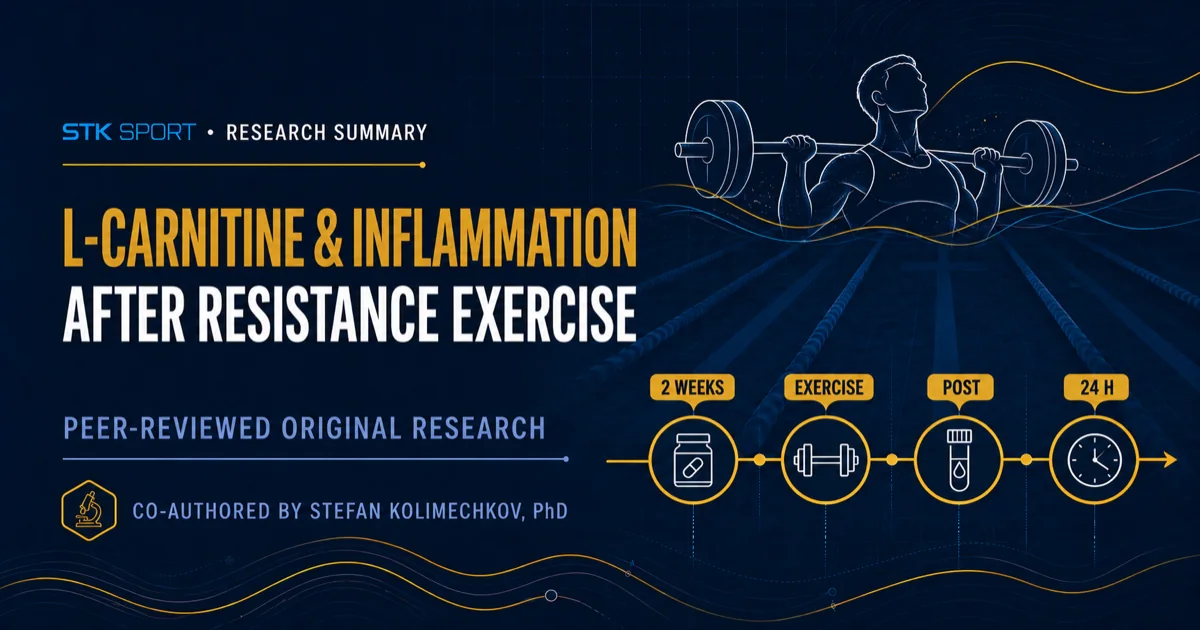
Can two weeks of L-carnitine influence the inflammatory response to resistance exercise?
L-carnitine contributes to fatty-acid transport into mitochondria and has also been investigated for antioxidant and anti-inflammatory effects. The researchers examined whether supplementation changed pro- and anti-inflammatory cytokines, nitric oxide and blood-pressure responses surrounding one high-intensity resistance-exercise session.
The question was tested in non-athletic overweight young men rather than trained athletes, allowing the acute response to be examined in a clearly defined population.
How did L-carnitine and placebo compare across cytokine, nitric-oxide and blood-pressure measurements before and after exercise?
A randomised, double-blind, placebo-controlled trial with four measurement points.
Twenty men completed the study: ten received 2 g/day of L-carnitine and ten received placebo for two weeks before one high-intensity resistance-exercise session.
Random allocation, participant and researcher blinding, a placebo comparison and repeated measurements strengthened the study’s ability to examine changes across the protocol.
- Baselinefasting blood sample and blood pressure before supplementation
- Pre-exerciseafter two weeks of L-carnitine or placebo
- Immediatemeasurements directly after resistance exercise
- 24 hoursfollow-up during early recovery
Overweight, non-athletic young men
The final groups were comparable at baseline. Participants reported no regular exercise during the previous six months and met the study’s health and lifestyle eligibility criteria.
Seven whole-body exercises
Bench press, lat pulldown, leg extension, leg curl, biceps curl, triceps pushdown and shoulder press were completed for three sets to exhaustion at 85% of one-repetition maximum.
Cytokines, nitric oxide and blood pressure
Serum L-carnitine, IL-4, IL-8, TNFα and nitric oxide were measured alongside systolic and diastolic blood pressure at each study stage.
L-carnitine altered several cytokine responses, while blood pressure did not differ between groups.
The supplement group showed a more favourable pattern for IL-4, IL-8 and TNFα across the study stages, but not every measured outcome separated the groups.
IL-4 was better maintained
IL-4 increased after supplementation relative to baseline. The placebo group showed significant decreases after exercise, and between-group differences favoured L-carnitine before exercise, immediately afterwards and at 24 hours.
IL-8 was lower in the supplement group
IL-8 decreased after supplementation, rose immediately after exercise and then fell by 24 hours. Values were significantly lower than placebo at the three post-baseline measurement points.
TNFα showed a different acute pattern
TNFα decreased after supplementation and was lower than placebo before and immediately after exercise. In the placebo group, TNFα increased significantly immediately after exercise.
Blood-pressure responses were similar
Systolic and diastolic pressure rose immediately after exercise in both groups, but there were no significant between-group differences.
Nitric oxide followed the exercise response
Nitric oxide increased immediately after exercise and decreased by 24 hours in both groups. L-carnitine did not produce a significant between-group difference.
Serum L-carnitine increased as expected
Serum L-carnitine rose in the supplement group and was significantly higher than placebo after supplementation, immediately after exercise and at 24 hours.
A controlled signal worth investigating further, not a universal supplementation rule.
Within this small trial, two weeks of L-carnitine supplementation modified several inflammatory markers surrounding acute resistance exercise. The pattern supports further recovery research while remaining specific to the participants and protocol studied.
Inflammatory signalling may be modifiable
The cytokine differences suggest that short-term L-carnitine intake may influence the inflammatory response to a demanding resistance session. This provides a useful basis for larger trials that also measure recovery and performance directly.
Small, short and population-specific
- Only 20 non-athletic overweight young men completed the trial.
- The intervention lasted two weeks and examined one acute exercise session.
- Muscle-damage markers, antioxidant indices and epinephrine were not measured.
- The findings cannot automatically be generalised to women, trained athletes or longer supplementation periods.
No proven improvement in recovery or performance
- The study did not directly measure soreness, subsequent performance or return-to-training time.
- It does not establish an optimal dose for other populations or training programmes.
- It does not show that L-carnitine changed nitric oxide or blood pressure relative to placebo.
Read and cite the paper.
Use the DOI for the permanent scholarly record or read the complete open-access article hosted on STK SPORT.
Hakimi, M., Alimohammadi, M., Roukhandeh, H., & Kolimechkov, S. (2024). Effect of L-carnitine supplementation on pro- and anti-inflammatory responses and blood pressure changes following resistance exercise in non-athletic overweight young men. International Journal of Nutrition Sciences, 9(4), 281–290. https://doi.org/10.30476/ijns.2024.102272.1321