
Effect of glutathione supplementation on swimmers’ performance
Pedagogy of Physical Culture and Sports, 25(4), 215–224 · DOI 10.15561/26649837.2021.0403
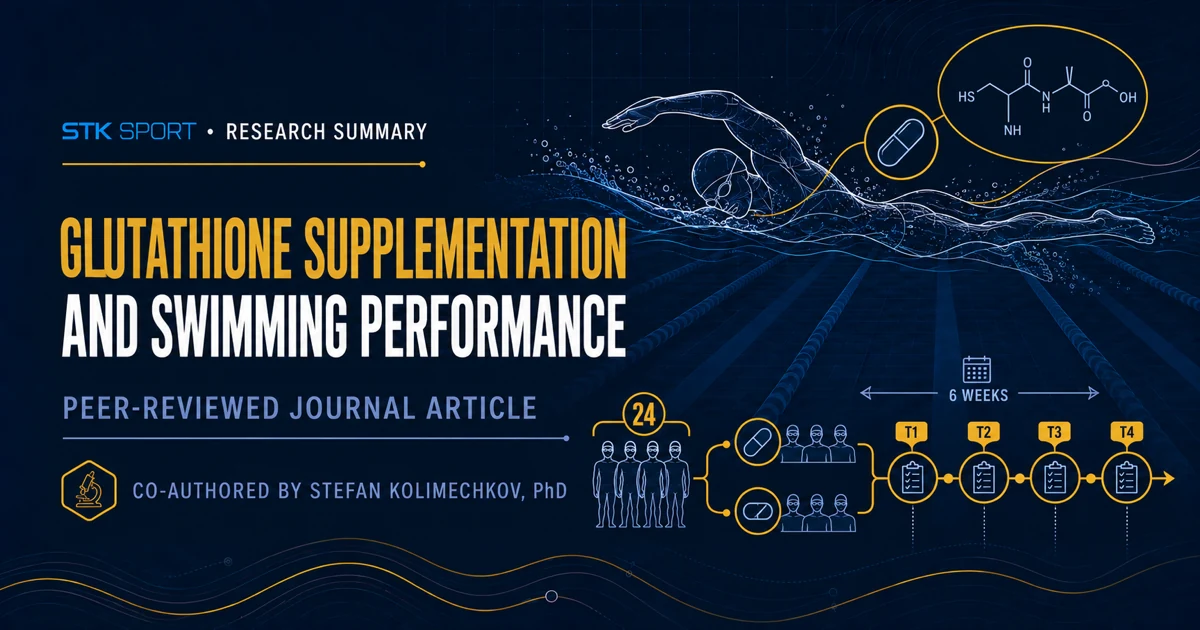
Testing supplementation under a rising training load.
Glutathione contributes to the body’s antioxidant defences, but the practical effect of oral supplementation in elite athletes was uncertain. The researchers therefore compared glutathione with a placebo during a six-week period in which weekly swimming volume increased from approximately 40 to 65 kilometres.
The study combined repeated measures of training distress and urinary hormones with anthropometry, reported nutrition and competition results from two national championships.
Did 250 mg of glutathione per day, compared with placebo, change recovery markers and competitive results during six weeks of training?
Two comparable groups followed across six weeks.
The double-blind, placebo-controlled study ran between two national championships while the swimmers completed ten training sessions per week.
Weekly swimming volume increased from approximately 40 to 65 kilometres. Measurements were taken on Mondays after around 60 hours without training.
- T1 · Day 1Baseline measures after recovery from the first championship
- T2 · Day 14Training distress and urine hormones
- T3 · Day 28Training distress and urine hormones
- T4 · Day 42Final measures before the second championship
Elite national-team swimmers
Twenty-four swimmers—10 women and 14 men—aged 15 to 25 years took part. Their mean age was 18.7 ± 3.78 years.
Glutathione versus placebo
Twelve swimmers took one 250 mg glutathione capsule daily; twelve took a visually matched 250 mg glucose placebo. Allocation and administration were double-blind.
Recovery, nutrition and performance
Training distress and urinary cortisol and cortisone were followed at four points. Anthropometry and food-frequency questionnaires were assessed at the beginning and end, and championship results were compared.
Competition results and final cortisol differed between groups.
The glutathione group showed a larger average improvement in competition performance and lower urinary cortisol at the final measurement point. Several measures remained similar between groups.
Lower final urinary cortisol
At T4, mean cortisol was 19.4 ng/mL in the glutathione group and 42.5 ng/mL in the placebo group (p<0.05).
Greater average performance improvement
Across competition-event observations, average change was −1.66% with glutathione and −0.97% with placebo (p=0.0329); a lower race time represents improvement.
More improved event results
The glutathione group improved in 41 of 43 event observations, compared with 29 of 42 in the placebo group. Worsened results numbered 2 and 13 respectively (p=0.0004).
Fewer swimmers worsened on average
No swimmer in the glutathione group had a worsened average competition result, compared with four swimmers in the placebo group (p=0.014).
Training distress fell in both groups
Training Distress Scale scores reduced by T4 in both groups, with no significant between-group difference at the final measurement.
Anthropometry and reported nutrition
No significant between-group or time-related differences were reported for the measured anthropometric or nutritional variables.
A promising controlled result, with an unresolved mechanism.
The authors linked lower final cortisol and greater competition progress to glutathione supplementation. The controlled design supports the group comparison, but it does not demonstrate how the supplement produced the observed differences.
Possible support for adaptation
In this group of elite swimmers, 250 mg of glutathione daily may have supported adaptation during six weeks of increasing training load. Any practical use should sit within an individualised nutrition and recovery plan guided by appropriately qualified professionals.
What constrains the result
- The sample comprised 24 swimmers from one national team and the study lasted six weeks.
- Plasma glutathione was not measured because the ethics committee did not permit blood sampling, so absorption and the biochemical pathway were not confirmed.
- Competition outcomes included multiple event observations from the same swimmers in real competition settings.
- Longer-term effects and transfer to other populations, sports or doses remain uncertain.
No universal performance rule
- It does not establish a universal performance benefit.
- Lower cortisol alone does not prove optimal recovery.
- Supplementation cannot replace training quality, nutrition, sleep, recovery practice or professional assessment.
Read and cite the paper.
Use the DOI for the permanent scholarly record or read the complete open-access article hosted on STK SPORT.
Petrov, L., Alexandrova, A., Kachaunov, M., Penov, R., Sheytanova, T., & Kolimechkov, S. (2021). Effect of glutathione supplementation on swimmers’ performance. Pedagogy of Physical Culture and Sports, 25(4), 215–224. https://doi.org/10.15561/26649837.2021.0403