
Physiological effects of microcurrent and its application for maximising acute responses and chronic adaptations to exercise
European Journal of Applied Physiology, 123(3), 451–465 · DOI 10.1007/s00421-022-05097-w
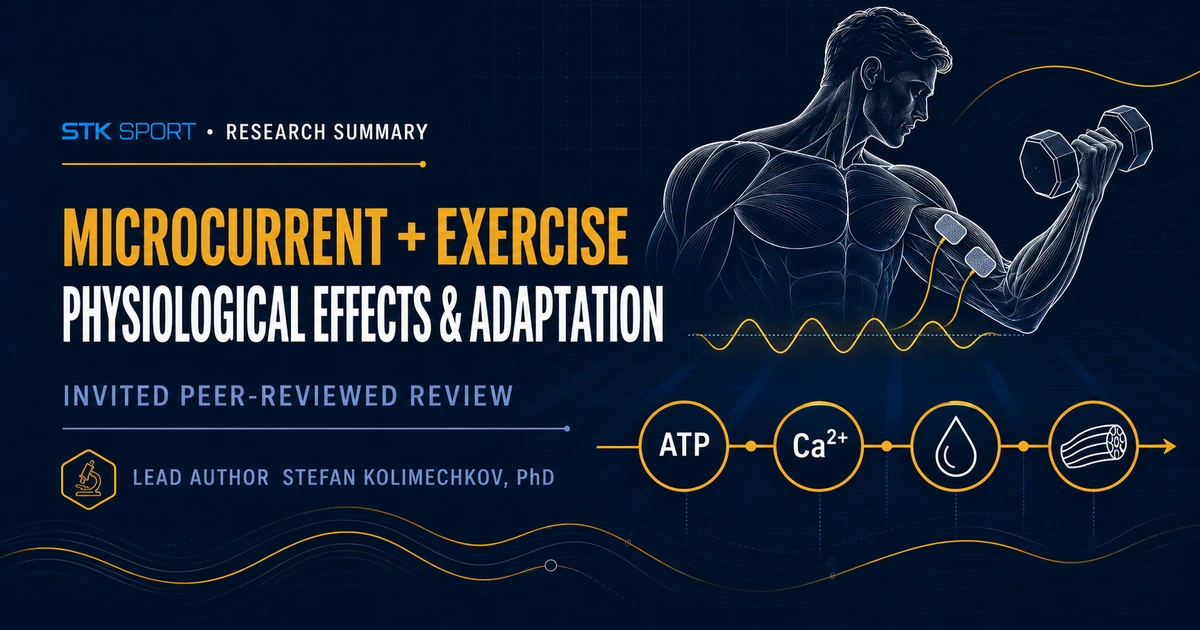
How might microcurrent influence the body’s response and adaptation to exercise?
The review brought together physiological explanations and human exercise studies involving endurance work, resistance exercise and exercise-induced muscle soreness.
Its purpose was to clarify the candidate mechanisms, describe what had been observed in healthy and physically active people, and show why protocol standardisation is essential for future research.
Which physiological pathways could be involved, what does the human evidence suggest, and what still prevents firm exercise recommendations?
Mapped mechanisms, protocols and outcomes across the exercise literature.
This invited narrative review examined microcurrent used with endurance and resistance exercise in healthy, physically active people, while drawing on relevant cellular, animal and clinical evidence to explain possible mechanisms.
The paper was an evidence-led narrative review. It did not report a systematic search, pooled meta-analysis or formal risk-of-bias assessment.
From microampere current to cellular response
The authors examined proposed pathways involving ATP resynthesis, intracellular calcium regulation, exercise-induced lipolysis and muscle protein synthesis.
Acute and longer-term exercise studies
The main table summarised 11 controlled studies spanning trained adults, endurance athletes, recreationally active people, university students and adults aged 65 years and above.
Current, timing and placement varied widely
The review compared intensity, frequency, waveform, application time, treatment duration and electrode placement across recovery, body-composition and performance outcomes.
Promising signals, but no single standardised microcurrent protocol.
The reviewed studies reported potentially useful effects for recovery, soreness, body composition and some muscle-function outcomes. The evidence was not uniform, and protocol differences made direct comparison difficult.
Four candidate physiological pathways
The review connected microcurrent with proposed effects on ATP resynthesis, intracellular calcium homeostasis, lipolysis and muscle protein synthesis. These pathways help frame future testing but are not all confirmed mechanisms in exercising humans.
Several studies reported less soreness or faster recovery
Controlled studies described attenuation of delayed-onset muscle soreness, improved recovery signals or reduced perceived exhaustion after exercise. Longer application protocols were prominent among the positive soreness findings.
Lipolysis and soreness results were not consistent
One acute endurance study found no additional lipolytic effect over sham, and one shorter microcurrent protocol found no benefit for muscle soreness. In resistance training, some between-group performance and muscle-architecture differences did not reach statistical significance.
Application methods differed substantially
Exercise studies varied in current intensity, frequency, waveform, treatment timing, duration and electrode placement. This heterogeneity was the central obstacle to identifying an optimal protocol for a specific outcome.
The review gives the field a clearer research framework.
Its strongest contribution is not a universal microcurrent prescription. It is the structured connection between plausible physiological pathways, observed exercise outcomes and the protocol details researchers must report to make future studies comparable.
Standardisation can move the evidence forward
Researchers can build on the review by reporting intensity, frequency, waveform, electrode position, application time and treatment duration alongside a clearly controlled exercise programme and outcome-specific measures.
What constrains the evidence
- The review did not report a systematic search or formal quality assessment.
- The human studies were generally small and highly heterogeneous.
- Some proposed mechanisms draw on animal, cellular or clinical evidence rather than direct verification in healthy exercising humans.
No universal treatment protocol
- It does not prove that microcurrent improves performance, recovery or body composition for every person.
- It does not identify one optimal device setting, timing or electrode placement.
- It does not replace exercise training, individual assessment or appropriately qualified professional care.
Read and cite the paper.
Use the verified DOI record or read the complete published article PDF.
Kolimechkov, S., Seijo, M., Swaine, I., Thirkell, J., Colado, J. C., & Naclerio, F. (2023). Physiological effects of microcurrent and its application for maximising acute responses and chronic adaptations to exercise. European Journal of Applied Physiology, 123(3), 451–465. https://doi.org/10.1007/s00421-022-05097-w