
Dynamics of training distress, performance, and excretion of cortisol and cortisone in urine during six weeks of training in elite swimmers
Human. Sport. Medicine, 20(S1), 84–91 · DOI 10.14529/hsm20s111
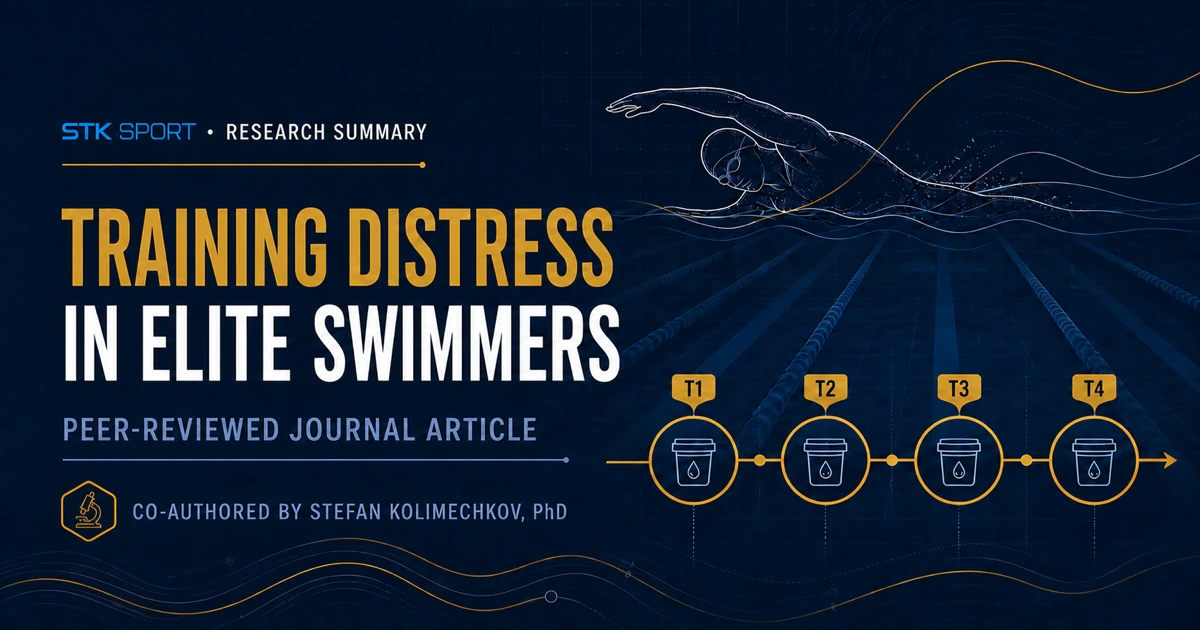
Monitoring training distress across six weeks.
Elite swimmers complete high volumes of repeated endurance training. That workload can improve performance, but a sustained mismatch between training and recovery may contribute to excessive fatigue or overtraining. Monitoring is difficult because individual physiological measures can vary substantially and may not tell the whole story on their own.
This study followed subjective training-distress symptoms alongside overnight urinary cortisol and cortisone during an increasing-volume training block. The purpose was to examine whether the measures changed together as the swimmers progressed through the six weeks.
Could a brief self-report scale and non-invasive urine measurements provide complementary information about how elite swimmers were responding to training?
One training block, observed at four points.
The same 24 swimmers were assessed repeatedly from the beginning to the end of a six-week general preparation phase.
The athletes trained twice a day from Monday to Friday. Measurements were taken on Monday mornings after approximately 60 hours without training.
- T1 · Day 1Training distress, urine hormones and anthropometry
- T2 · Day 14Training distress and urine hormones
- T3 · Day 28Training distress and urine hormones
- T4 · Day 42Training distress, urine hormones and anthropometry
National-team swimmers
Ten women and fourteen men from the Bulgarian national swimming team took part. Their mean age was 18.7 ± 3.78 years.
Training Distress Scale
A 19-item questionnaire recorded self-reported symptoms of training distress and performance readiness at each measurement point.
Urinary hormones
First-morning urine was analysed for cortisol and cortisone, with concentrations adjusted for urine specific gravity. Body composition was estimated at T1 and T4.
The clearest changes appeared later in the training block.
Training-distress scores and urinary cortisol were lower toward the end of the six weeks, while several other measures did not change significantly.
Training-distress score
The mean score was 6.92 ± 7.15 at T4, significantly lower than at T1 (14.96 ± 10.63) and T2 (15.21 ± 12.44).
Urinary cortisol
Mean cortisol concentration was significantly lower at T3 (35.9 ± 47.7 ng/mL) and T4 (35.0 ± 24.2 ng/mL) than at T1 (82.7 ± 62.8 ng/mL).
Combined hormone concentration
The sum of urinary cortisol and cortisone concentrations was significantly lower at T3 and T4 than at T1.
Cortisone and hormone ratio
Cortisone concentration and the cortisol-to-cortisone ratio did not differ significantly across the four measurement points.
Body composition
The study reported no statistically significant changes in the measured body-composition parameters between T1 and T4.
Volume increased
The planned weekly swimming volume rose by 5 km each week, from 40 km in week one to 65 km in week six.
Useful signals, interpreted together.
The authors interpreted the parallel reduction in distress symptoms and urinary cortisol as being consistent with good recovery after the weekend rest period. The evidence supports a cautious, combined-monitoring interpretation—not a standalone diagnostic claim.
Combine subjective and physiological context
A brief self-report measure may be a practical addition to longitudinal athlete monitoring. Hormone measurements can add context, but should be interpreted alongside workload, symptoms and other relevant information.
What constrains the result
- This was a six-week, single-group study of 24 swimmers from one national team, with no separate comparator group.
- Cortisol values showed wide variability; at T1 the reported mean was 82.7 ± 62.8 ng/mL.
- Three participants reported that the first-morning sample was not their only urine during the night.
- No direct swimming-performance test was reported during the study period.
No universal recovery rule
- Lower cortisol alone does not prove optimal recovery.
- The measures used here do not diagnose overtraining.
- The findings should not be generalised automatically beyond this population and training phase.
Read and cite the paper.
Use the DOI for the permanent scholarly record or open the full paper PDF hosted on STK SPORT with permission.
Izov, N., Alexandrova, A., Petrov, L., Kachaunov, M., Sheytanova, T., & Kolimechkov, S. (2020). Dynamics of training distress, performance, and excretion of cortisol and cortisone in urine during six weeks of training in elite swimmers. Human. Sport. Medicine, 20(S1), 84–91. https://doi.org/10.14529/hsm20s111