
Effects of microcurrent with exercise on muscle soreness: a meta-analysis
Revista Iberoamericana de Ciencias de la Actividad Física y el Deporte, 15(2), 247–267 · DOI 10.24310/riccafd.15.2.2026.24090
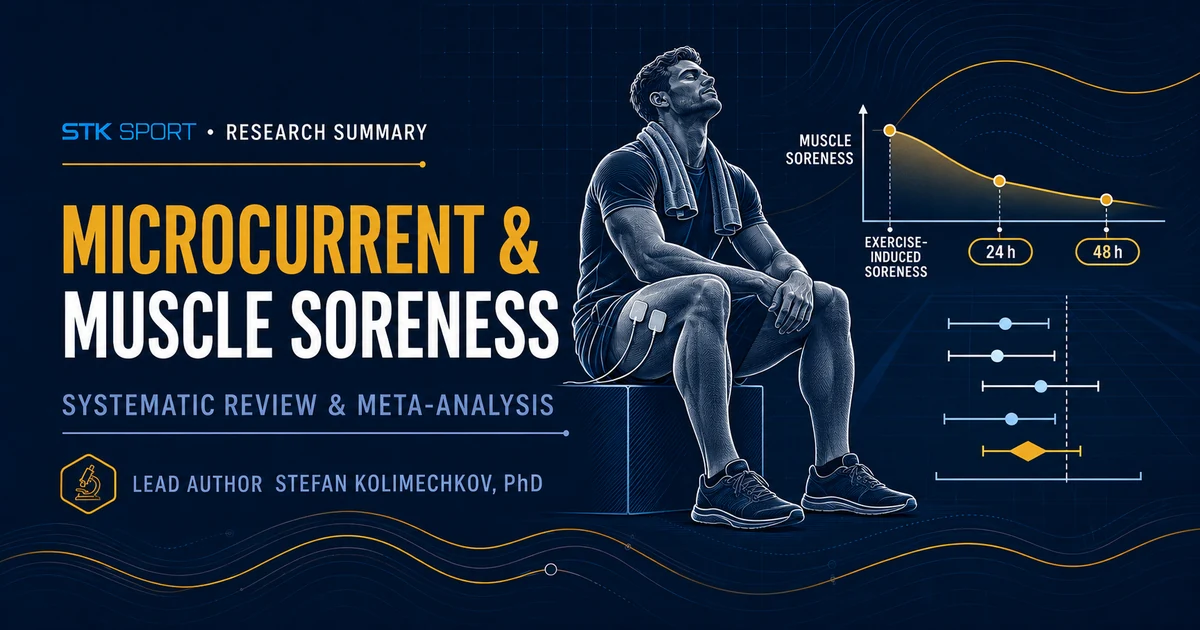
Does adding microcurrent to exercise measurably improve recovery outcomes?
Microcurrent therapy uses low-intensity, sub-sensory electrical current. Individual trials had reported mixed findings for post-exercise soreness, body composition and physical performance.
This study moved beyond a narrative overview by systematically identifying randomised trials and pooling comparable outcomes to estimate whether microcurrent added benefits beyond exercise with sham treatment.
Compared with sham treatment, does microcurrent combined with exercise reduce muscle soreness or improve body composition and performance in healthy adults?
A registered PRISMA review of randomised controlled trials.
The team searched major scientific databases through March 2026 for trials in healthy adults comparing exercise with microcurrent against the same exercise with sham or no electrical stimulation.
The protocol was registered prospectively with PROSPERO (CRD42023434009). Two reviewers independently screened studies and assessed risk of bias, with a third reviewer available to resolve disagreements.
- 4,349 recordsidentified through database searching
- 2,650 screenedafter duplicate removal
- 11 trialsincluded in qualitative synthesis
- 7 studiesincluded in quantitative synthesis
Healthy adults across training levels
Eligible trials involved adults aged 18 years or above, ranging from untrained and recreationally active participants to trained athletes.
Exercise with microcurrent versus sham
Resistance or endurance exercise was combined with microcurrent at or below 1 mA, applied before, during or immediately after exercise.
Recovery, body composition and performance
Random-effects meta-analyses examined delayed-onset muscle soreness, fat mass and maximal strength where at least three studies supplied comparable data.
Microcurrent reduced soreness at 24 and 48 hours, but not at 72 hours.
The pooled results support a moderate reduction in delayed-onset muscle soreness during the first two days after exercise-induced muscle damage. The same evidence did not show significant improvements in fat mass or maximal strength.
Less soreness at 24 hours
Four studies favoured microcurrent with a moderate pooled effect: g = −0.63 (95% CI −1.07 to −0.19).
Less soreness at 48 hours
Four studies again favoured microcurrent: g = −0.52 (95% CI −0.96 to −0.09).
No clear pooled effect at 72 hours
Across three studies, the confidence interval crossed no effect: g = −0.27 (95% CI −0.76 to 0.22).
Fat mass and maximal strength were unchanged
The pooled estimates were not significant for fat-mass percentage, absolute fat mass or maximal strength. Only one eligible study reported endurance performance, preventing a pooled endurance estimate.
No adverse events were reported
None of the included trials reported adverse events or negative physiological responses associated with the microcurrent applications studied.
Effective protocols were not yet identifiable
Current intensity, frequency, waveform, application duration and electrode placement varied substantially, limiting conclusions about an optimal protocol.
A focused recovery signal, not a universal performance effect.
The study strengthens the evidence that microcurrent may be useful as an adjunct for reducing post-exercise soreness in healthy adults. Its contribution is equally clear about where the evidence does not show an added benefit.
A potential adjunct during early recovery
For athletes and physically active adults, reduced soreness at 24 and 48 hours may support comfort and continuity between demanding sessions. This practical possibility still requires individual assessment and appropriately designed protocols.
What constrains the evidence
- Only a small number of trials contributed to each pooled outcome.
- Individual trials were small, with samples ranging from 18 to 42 participants.
- Microcurrent settings, timing and electrode placement varied substantially.
- Fewer than ten studies contributed to each synthesis, limiting assessment of publication bias.
No general recovery prescription
- It does not identify one optimal current, frequency, waveform or treatment duration.
- It does not show added benefits for maximal strength or body composition.
- It does not establish that a statistically significant reduction in soreness is clinically important for every individual.
Read and cite the paper.
Use the verified DOI record or read the complete open-access published article from the University of Greenwich repository.
Kolimechkov, S., Seijo, M., Thirkell, J., Larumbe-Zabala, E., & Naclerio, F. (2026). Effects of microcurrent with exercise on muscle soreness: a meta-analysis. Revista Iberoamericana de Ciencias de la Actividad Física y el Deporte, 15(2), 247–267. https://doi.org/10.24310/riccafd.15.2.2026.24090