
Some metrological aspects of measurements of quantitative characteristics during a hypoxic training of elite rowers
2019 XXIX International Scientific Symposium “Metrology and Metrology Assurance” (MMA), 150–153 · DOI 10.1109/MMA.2019.8935990
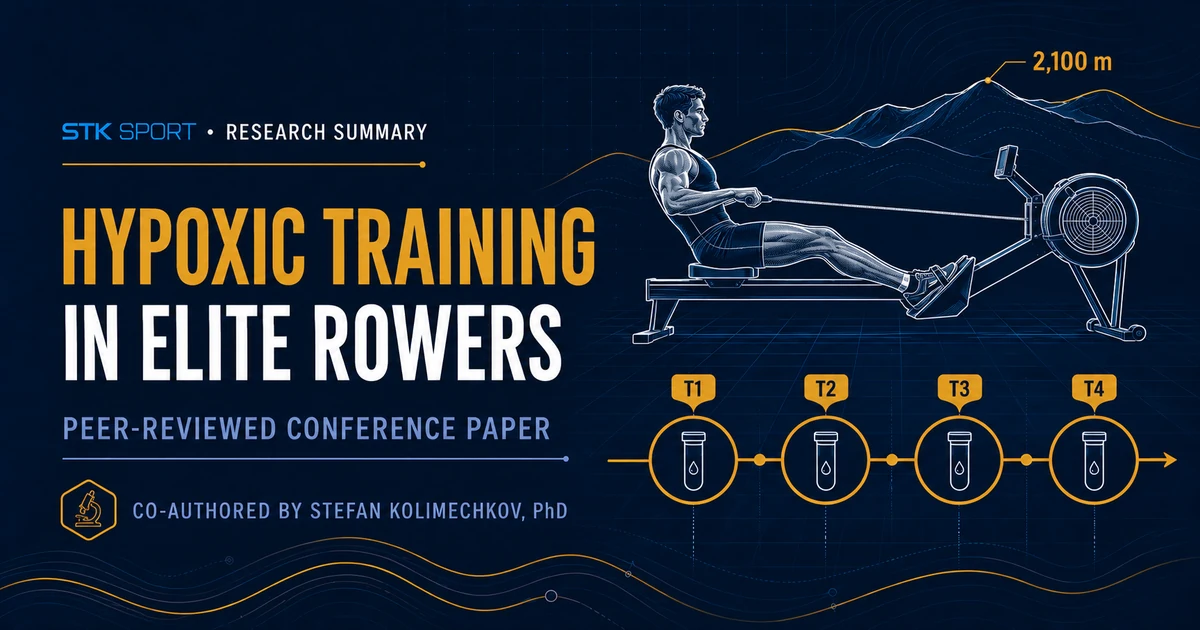
Reliable altitude-training decisions depend on measuring the environment, the athlete and performance together.
For elite rowers, living and training at altitude is intended to stimulate adaptations that support oxygen transport and aerobic performance. Interpreting those responses requires controlled equipment, repeatable testing and careful separation of genuine haematological adaptation from temporary haemoconcentration.
This study combined environmental oxygen monitoring, standardised ergometer testing and repeated blood sampling across and after a three-week natural-altitude camp.
Which blood changes remained after the athletes returned from altitude, and did the measured rowing-performance indicators improve?
They followed elite rowers before, during and after a three-week camp at 2,100 metres.
Sixteen male athletes from the Bulgarian national rowing team, aged 17 to 26 years, completed the same living-high, training-high programme at Belmeken. The camp formed part of the team’s annual training plan.
Oxygen concentration was measured daily with a Haldane gas-analysis apparatus calibrated every three days. The recorded concentration remained stable at 16.0 ± 0.2%.
- T1 · 7 days beforeBaseline blood sampling and standardised incremental rowing test
- T2 · Camp endBlood sampling after three weeks of natural-altitude training
- T3 · 7 days afterFollow-up blood assessment after return to lower altitude
- T4 · 18 days afterFinal blood assessment and post-camp performance comparison
Natural hypoxia was measured throughout
The researchers monitored oxygen concentration alongside barometric and environmental conditions so the altitude exposure was documented rather than assumed.
Nine haematological and biochemical indicators
Venous samples were analysed for haemoglobin, red and white blood cells, haematocrit, reticulocytes, platelets, iron, total iron-binding capacity and total plasma protein.
A calibrated incremental ergometer test
Each test used four three-minute stages separated by 30-second rests on the same Concept2 ergometer. Power increased by 40 W per stage, with drag factor fixed at 130; lactate, PWC170 and estimated VO2max were assessed.
Several blood values rose at altitude, then returned to their initial levels after the camp.
At T2, haemoglobin, haematocrit, red blood cells, reticulocytes, platelets and total plasma protein were significantly higher than at baseline. By T3, the reported values had returned to their initial levels and remained close to baseline at T4.
Haemoglobin increased by 8.5 g/L
Mean haemoglobin rose from 147.9 ± 7.14 to 156.4 ± 5.63 g/L at the end of the camp (p<0.001 versus T1).
Haematocrit and red-cell count increased
Haematocrit rose by 0.03 L/L and red blood cells by 0.39 T/L at T2 (p<0.001 versus T1). Reticulocytes also increased significantly.
Platelets and plasma protein also increased
Platelets rose from 207.4 ± 43.37 to 247.7 ± 44.85 G/L, while total plasma protein rose from 58.50 ± 7.49 to 66.50 ± 4.82 g/L (p<0.001 versus T1).
The haematological increases were not sustained
One week after the camp, haemoglobin, haematocrit, red blood cells, reticulocytes, platelets and plasma protein had returned to their initial levels; this pattern was still evident at T4.
The reported rowing-performance measures did not improve
No statistically significant pre-to-post differences were found for PWC170 or power at the 4 mmol/L anaerobic threshold. The paper likewise did not report a significant improvement in estimated VO2max.
The pattern was consistent with haemoconcentration
Because platelets and plasma protein rose alongside the haemoglobin-related variables and then normalised after descent, the authors interpreted much of the T2 change as reduced plasma volume rather than a lasting rise in red-cell mass.
Altitude responses are easier to interpret when measurement quality and plasma-volume effects are considered together.
The paper’s central value is metrological as well as physiological: it demonstrates how environmental control, equipment calibration, repeated blood sampling and functional testing can prevent a temporary concentration effect from being mistaken for a durable performance adaptation.
Monitor the measurement process, not only the final number
For altitude camps, coaches and sport scientists may benefit from considering haemoglobin alongside haemoglobin-independent indicators such as platelets and total plasma protein, while also checking whether any blood response is accompanied by a meaningful performance change.
A focused observational camp study
- The sample comprised 16 male rowers from one national team and there was no non-altitude control group.
- The study examined one three-week natural-altitude camp and a limited follow-up period.
- Total haemoglobin mass and plasma volume were not measured directly.
- The proposed correction equation was derived from this dataset and requires independent validation.
No universal altitude-training formula
- The study does not show that living high and training high improves performance for every rower.
- A temporary rise in haemoglobin concentration does not by itself prove increased red-cell mass.
- The proposed equation should not be treated as a replacement for validated direct measurement methods.
Read and cite the paper.
Use the registered DOI or consult the official MMA proceedings archive.
Bachev, V., Petrov, L., Alexandrova, A., Neykov, S., Kolimechkov, S., & Mihaylov, V. (2019). Some metrological aspects of measurements of quantitative characteristics during a hypoxic training of elite rowers. In 2019 XXIX International Scientific Symposium “Metrology and Metrology Assurance” (MMA) (pp. 150–153). IEEE. https://doi.org/10.1109/MMA.2019.8935990