
Application of hypoxicators in the rowers’ training
Pedagogics, Psychology, Medical-Biological Problems of Physical Training and Sports, 23(5), 239–245 · DOI 10.15561/18189172.2019.0505
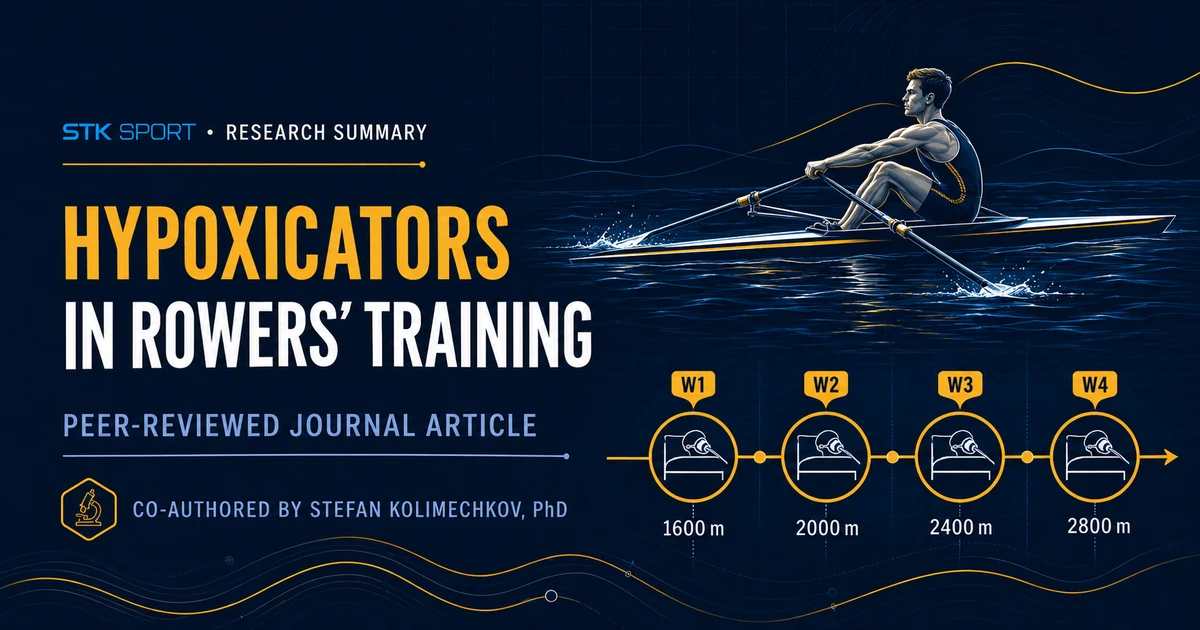
Simulated altitude may alter the blood without necessarily improving rowing performance.
Hypoxicators allow coaches and researchers to control simulated altitude while athletes continue training at a lower elevation. The intended response includes stimulation of red-blood-cell production and haemoglobin, which could support oxygen transport.
This study tested whether four weeks of night-time normobaric hypoxia, added to a shared rowing training camp, changed haematological measures or submaximal rowing performance in national youth-team athletes.
Would progressively higher simulated altitude during sleep improve blood oxygen-carrying markers and functional rowing performance?
They compared the same rowing camp with and without night-time hypoxic exposure.
Sixteen Bulgarian national youth-team rowers were divided into an experimental group and a control group of eight. Both groups followed the same one-month training programme at a dam approximately 600 metres above sea level.
The experimental group used MAG-20 hypoxicators for eight hours during sleep. Simulated altitude increased from 1600 to 2800 metres over four weekly stages.
- Week 1 · 1600 mEight hours of simulated altitude during each night’s sleep
- Week 2 · 2000 mShared rowing programme continued at the training camp
- Week 3 · 2400 mNight-time normobaric hypoxia progressed by another 400 metres
- Week 4 · 2800 mFinal exposure stage before post-camp reassessment
National youth-team rowers
The athletes had a mean age of 17.13 ± 0.83 years and approximately four to five years of training experience. All provided informed consent under the study’s stated Helsinki Declaration procedures.
A repeatable submaximal ergometer test
Four three-minute stages on a Concept II ergometer began at 200 W and increased by 40 W, with heart rate and capillary blood lactate used to estimate PWC170, the 4 mmol/L anaerobic threshold and VO2max.
Haematology before and after the camp
Venous blood, anthropometry and bioelectrical-impedance body composition were assessed at the beginning and end. The haematology panel included haemoglobin, erythrocytes, haematocrit, MCV and MCHC.
Blood oxygen-carrying markers increased, but measured rowing performance did not.
After four weeks, the experimental group showed higher haemoglobin concentration and erythrocyte count. The submaximal performance measures did not change significantly within or between groups.
Haemoglobin concentration increased
In the experimental group, haemoglobin rose from 156.25 ± 4.11 to 162.75 ± 4.11 g/L (p<0.01). The post-camp value was also higher than in the control group.
Erythrocyte count increased
The experimental group’s erythrocyte count rose from 5.26 ± 0.13 to 5.49 ± 0.10 T/L (p<0.01), with a higher post-camp value than the control group.
No significant functional improvement was detected
PWC170, estimated VO2max, the 4 mmol/L anaerobic threshold and associated relative measures showed no significant pre-to-post or between-group changes.
Body measures remained stable
Weight, BMI, body-fat percentage and relative muscle mass did not change significantly during the one-month training period.
Red-cell indices changed in both groups
Haematocrit decreased slightly in the experimental group, while MCV decreased and MCHC increased in both groups. The authors discussed whether these changes could affect blood rheology.
The submaximal test produced repeatable results
Pre-to-post correlations ranged from r = 0.60 for heart rate at AnT-4 to r = 0.90 for estimated relative VO2max, supporting its use for longitudinal monitoring without disrupting training.
The intervention changed key blood markers without producing a measurable performance gain.
This is an important distinction for applied sport science. A physiological response can show that an intervention affected the body, while the athlete-facing outcome still remains unchanged under the tested protocol.
Blood markers and performance should be considered together
Night-time hypoxia may stimulate erythrocyte and haemoglobin responses, but those changes should not be treated as proof of improved rowing capacity. The study also supports a practical submaximal test for monitoring trained rowers during a camp.
A focused four-week team study
- The sample contained 16 national youth-team rowers divided into two groups of eight.
- The study covered one training camp and one progressively increasing hypoxia schedule.
- VO2max was estimated from a submaximal rowing test rather than measured directly.
- Blood viscosity and erythrocyte deformability were discussed as possible mechanisms but were not measured directly.
No universal hypoxic-training prescription
- The study does not show that hypoxicators improve rowing performance in every setting.
- It does not identify the optimal simulated altitude, exposure duration or recovery schedule.
- Higher haemoglobin or erythrocyte values alone should not be interpreted as guaranteed performance improvement.
Read and cite the paper.
Use the verified journal record or read the complete article hosted on STK SPORT.
Neykov, S., Bachev, V., Petrov, L., Alexandrova, A., Andonov, S., & Kolimechkov, S. (2019). Application of hypoxicators in the rowers’ training. Pedagogics, Psychology, Medical-Biological Problems of Physical Training and Sports, 23(5), 239–245. https://doi.org/10.15561/18189172.2019.0505