
Erythrocyte oxidative status after maximal aerobic test in wrestlers
Human. Sport. Medicine, 19(1), 15–21 · DOI 10.14529/hsm190102
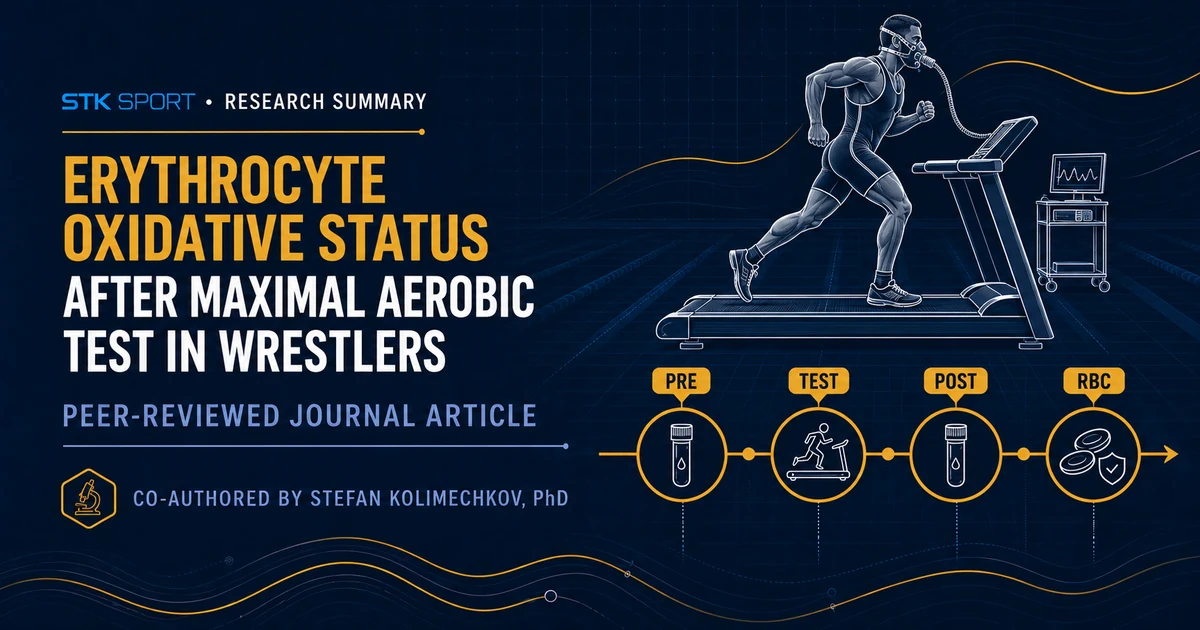
Maximal exercise challenges oxygen transport and antioxidant protection at the same time.
Erythrocytes operate in constant contact with oxygen and contain antioxidant systems that help limit oxidative damage. During intense exercise, changes in pH, temperature, mechanical stress and reactive oxygen species can also increase the breakdown of less-resistant red blood cells.
This study examined the immediate erythrocyte response to a standardised maximal aerobic test in trained wrestlers, bringing exercise-performance testing and laboratory oxidative-status assessment together.
How does a treadmill test to exhaustion affect lipid peroxidation, glutathione and antioxidant-enzyme activity in wrestlers’ erythrocytes?
They compared venous blood immediately before and after a maximal treadmill test.
Twelve international-level wrestlers completed an incremental treadmill protocol to exhaustion while respiratory gases were analysed. Erythrocytes were isolated from pre-test and immediate post-test blood samples for laboratory analysis.
The protocol began at 6 km/h, increased by 1.2 km/h every 1 minute 30 seconds and maintained a 2.5% incline.
- Pre-test screeningMedical examination, anthropometry and body composition
- Baseline bloodVenous sample collected before the exercise test
- Maximal treadmill testIncremental running to exhaustion with real-time gas analysis
- Immediate post-test bloodErythrocyte oxidative markers and plasma haemoglobin reassessed
International-level wrestlers
Nine men and three women took part after medical screening and informed consent. The study reported ethics approval and compliance with the Declaration of Helsinki.
VO2max and exhaustion
Expired oxygen and carbon dioxide were analysed in real time. Mean test duration was approximately 10 minutes for women and 13 minutes for men.
Oxidative damage and antioxidant defence
Spontaneous and induced lipid peroxidation, total glutathione and the activities of SOD, CAT and GPx were determined; plasma haemoglobin was used as an index of haemolysis.
The post-test erythrocyte profile showed lower lipid peroxidation and higher GPx activity.
Immediately after the maximal test, plasma haemoglobin increased, both measured forms of erythrocyte lipid peroxidation decreased, and glutathione peroxidase activity increased. Several other antioxidant measures were unchanged.
Plasma haemoglobin increased
Plasma haemoglobin approximately doubled in both women and men after the maximal test (p<0.01), which the authors interpreted as evidence consistent with exercise-induced intravascular haemolysis.
Spontaneous lipid peroxidation decreased
Spontaneous LPO fell from 5.43 ± 0.57 to 4.06 ± 0.30 µmol/gHb (p<0.01).
Induced lipid peroxidation also decreased
Induced LPO fell from 30.95 ± 3.34 to 22.25 ± 1.84 µmol/gHb (p<0.01).
Glutathione peroxidase activity increased
GPx activity rose from 9.00 ± 0.35 to 10.03 ± 0.49 U/mg Hb (p<0.01).
tGSH, SOD and CAT did not change significantly
Total glutathione and the activities of superoxide dismutase and catalase showed no statistically significant immediate pre-to-post differences.
More resistant erythrocytes may have remained in circulation
The authors proposed that exercise preferentially removed older, more oxidatively modified cells, leaving erythrocytes with lower membrane damage and stronger antioxidant protection.
A detailed laboratory view of how trained wrestlers’ red blood cells respond immediately after maximal aerobic work.
The findings add nuance to exercise-oxidative-stress research: intense exercise did not simply raise every marker of oxidative damage, and the response may reflect both haemolysis and antioxidant adaptation.
Training status may shape erythrocyte resilience
The selective response is consistent with the possibility that regularly trained athletes maintain a circulating population of red blood cells that is relatively resistant to oxidative stress. This is a physiological interpretation, not a clinical screening rule.
A small, immediate-response study
- The sample comprised 12 wrestlers from one athletic population.
- There was no non-athlete or non-exercise control group.
- Blood was reassessed immediately after exercise, without a longer recovery follow-up.
- The proposed removal of older erythrocytes was inferred rather than measured directly by cell-age markers.
No diagnostic or universal recovery rule
- The study does not show that one oxidative marker can diagnose fatigue, health or recovery.
- It does not prove the proposed cell-turnover mechanism.
- It does not establish that the same response occurs in every sport, training status or exercise protocol.
Read and cite the paper.
Use the verified journal record or read the complete article hosted on STK SPORT.
Alexandrova, A., Petrov, L., Makaveev, R., Tsvetanova, E., Georgieva, A., & Kolimechkov, S. (2019). Erythrocyte oxidative status after maximal aerobic test in wrestlers. Human. Sport. Medicine, 19(1), 15–21. https://doi.org/10.14529/hsm190102