
Physiological and biochemical changes after a programmed kumite in male Shotokan karate practitioners
Archives of Budo Science of Martial Arts and Extreme Sports, 14, 171–178 · AoBID 12616
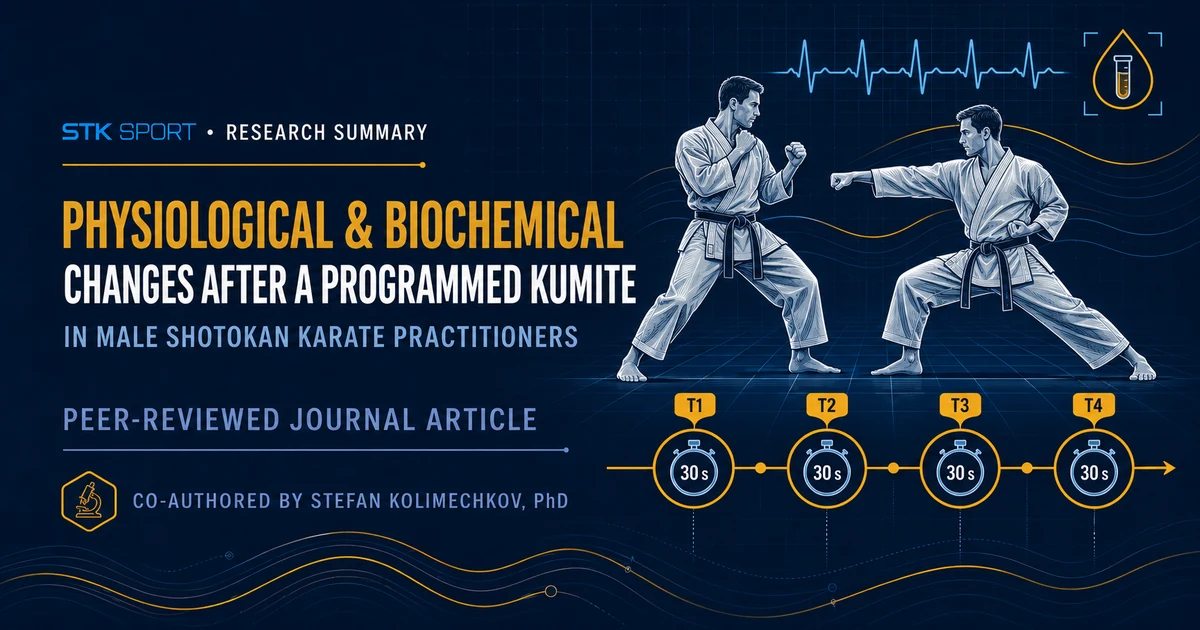
Karate needs tests that are both repeatable and relevant to competition.
Coaches need practical ways to assess whether athletes are prepared for the intense, intermittent demands of kumite. A useful test must be controlled enough to repeat while retaining the movement patterns and physiological strain of the sport.
This study compared blood-lactate responses from genuine championship bouts with a standardised two-minute kumite sequence performed at a pre-competition training camp. Heart rate and movement were also monitored during the programmed test.
Can a programmed two-minute kumite reproduce physiological intensity close to a high-intensity competition bout?
They compared championship responses with a standardised kumite test.
Fourteen male national-team practitioners were assessed during competition. Ten of them later completed the programmed-kumite stage, where heart rate and three-dimensional movement were monitored continuously and capillary lactate was measured before and after the test.
The programmed test lasted two minutes and comprised four consecutive 30-second attacking or counterattacking phases.
- Aerobic profileMaximal cycle-ergometer test before the field stages
- Championship boutsLactate after warm-up and after successive contest rounds
- Programmed kumiteFour fixed 30-second striking and counterattacking phases
- Response comparisonHeart rate, movement and lactate interpreted against competition
National-team Shotokan athletes
The sample comprised 14 men aged 18–29 years from the Bulgarian national kumite team. Ten completed the programmed-kumite stage.
Four defined technical phases
The sequence progressed from kizami-zuki to combinations with gyaku-zuki, mawashi geri and a final deai counterattack phase.
Heart rate and capillary lactate
Heart rate was monitored throughout the programmed test. Capillary blood lactate was assessed before and after the test and during the competition stage.
The programmed test produced a clear metabolic response and intensity close to competition.
Every athlete in the programmed stage showed a post-test rise in blood lactate, while heart rate remained consistently high throughout the two-minute workload.
Competition lactate rose after the first two bouts
Mean lactate increased from 1.3 ± 0.27 mmol/L after warm-up to 4.8 ± 2.55 after bout one and 6.5 ± 3.09 after bout two. The first rise was significant at p<0.001 and the second at p<0.05.
Programmed kumite increased lactate in all ten athletes
Mean lactate rose from 1.3 ± 0.25 before the test to 3.5 ± 0.74 mmol/L afterwards (p<0.05).
The programmed response did not differ significantly from bout one
The post-test mean of 3.5 ± 0.74 mmol/L was not significantly different from the 4.8 ± 2.55 mmol/L recorded after the first competition bout (p>0.05).
Heart rate remained high throughout the programmed workload
Mean heart rate was 168.7 ± 5.43 bpm, approximately 90% of the maximal heart rate observed during aerobic testing, and was broadly stable during the test.
The third-bout estimate came from only three athletes
Mean lactate after the third bout was 4.8 ± 0.96 mmol/L and was not significantly lower than after bout two, but only three competitors progressed to that round.
The model may support specific pre-competition testing
The authors concluded that the programmed kumite approached the intensity of high-intensity competition bouts and could serve as a sport-specific test within pre-competition preparation.
A practical contribution to sport-specific karate assessment.
The study offers a controlled protocol that preserves recognisable kumite actions while producing measurable physiological strain.
A repeatable test for preparation and monitoring
Used alongside coaching observation and other performance information, the programmed sequence may help practitioners compare responses across training periods without relying on competition access every time.
A focused national-team field study
- The sample was small and drawn from one male national team.
- Ten athletes completed the programmed stage, and only three reached the third competition bout.
- The proposed preparation interpretation was not independently validated against later competitive outcomes.
No universal readiness threshold
- The study does not define a universal lactate target for kumite athletes.
- It does not show that one biomarker can diagnose readiness or recovery.
- It does not establish that the test predicts competition results or generalises to every karate population.
Read and cite the paper.
Use the verified journal issue record or read the complete open-access article.
Petrov, L., Penov, R., Kolimechkov, S., & Alexandrova, A. (2018). Physiological and biochemical changes after a programmed kumite in male Shotokan karate practitioners. Archives of Budo Science of Martial Arts and Extreme Sports, 14, 171–178.