
Competitive bout model as a tool for estimation of female karateka specific endurance
European Journal of Physical Education and Sport Science, 4(9), 30–41 · DOI 10.46827/ejpe.v0i0.1827
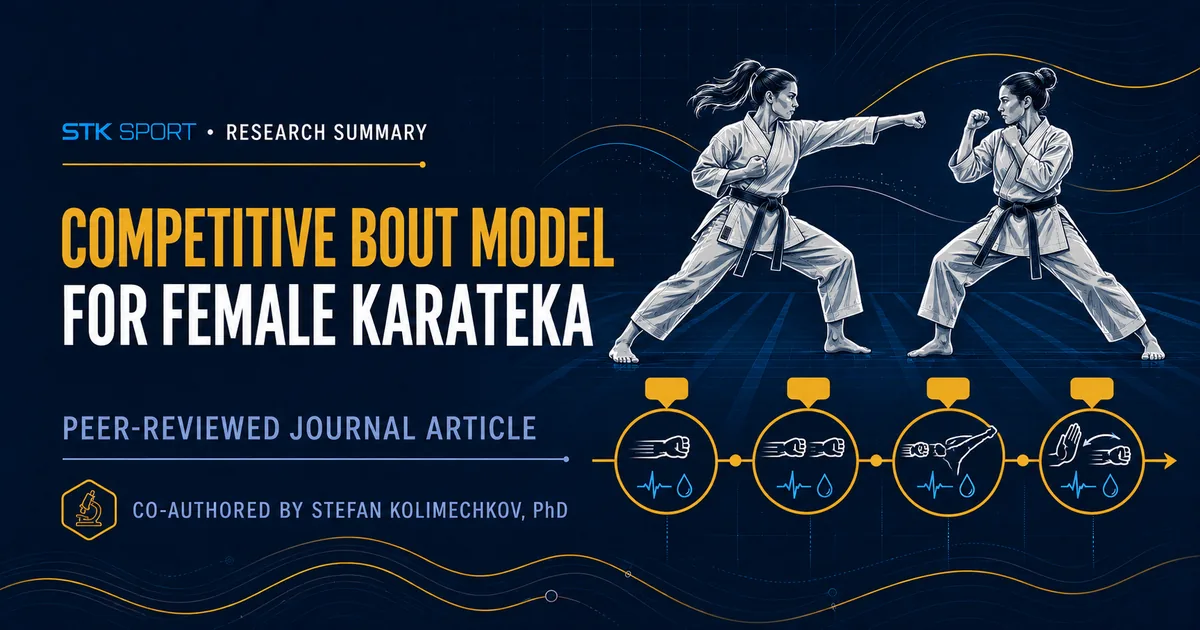
Female karateka need assessment that reflects the demands of real kumite.
Competition provides the most relevant performance setting, but it is difficult to standardise and repeat. Coaches therefore need practical tests that preserve recognisable karate actions while producing measurable physiological strain.
This study connected data from a national Shotokan championship with a programmed training model performed by the same female national-team cohort. It examined whether the controlled sequence produced responses comparable with competitive bouts.
Can a repeatable karate-specific model help estimate the endurance demands experienced by female kumite athletes?
They linked national-championship data with a controlled karate-specific model.
Seven female Bulgarian national-team Shotokan competitors were assessed during a championship. At a later pre-competition camp, those athletes and one additional sparring partner completed a programmed sequence while heart rate, movement and capillary blood lactate were monitored.
The training model comprised four consecutive 30-second phases, progressing from a single punch to combinations and a final interception-and-counter phase.
- Athlete profileAnthropometry, body composition and maximal aerobic capacity
- Championship stageLactate after warm-up and successive two-minute bouts
- Training modelFour programmed attacking or counterattacking phases
- Response comparisonCompetition and training demands interpreted together
National-team women
The championship sample comprised seven women aged 18–30 years who had placed in the top three of their categories at the 2016 National Shotokan Karate Championships.
Four defined technical phases
The sequence progressed from kizami-zuki to combinations with gyaku-zuki and mawashi geri, then a deai interception with a counterattack.
Heart rate, lactate and aerobic capacity
Heart rate and movement were recorded during the training model, lactate was measured across both settings, and VO2max was assessed by maximal cycle ergometry.
The model produced a consistent lactate response and reflected meaningful competition demands.
Blood lactate rose in every woman who completed the training model. Competition values increased across the first two bouts, showing the accumulating metabolic demand of successive kumite rounds.
Competition lactate rose after the first two bouts
Mean lactate increased from 1.1 mmol/L after warm-up to 3.9 mmol/L after bout one (p<0.001), then to 6.0 mmol/L after bout two (p<0.05).
Lactate increased in all eight women
Mean capillary blood lactate rose from 1.2 mmol/L before the programmed model to 3.2 mmol/L afterwards.
The model approached the first-bout response
The post-model mean of 3.2 mmol/L was close to the 3.9 mmol/L mean recorded after the first championship bout.
Heart rate was high during the training model
Mean heart rate during the programmed sequence was 171 ± 4.14 bpm, confirming substantial cardiovascular demand.
The third bout did not produce a further significant rise
Mean lactate after bout three was 6.6 mmol/L and did not differ significantly from bout two, although only two athletes reached that stage.
The model may support specific-endurance assessment
The authors concluded that the model reflected competition load and that lactate could contribute useful information when assessing physical load and karate-specific endurance.
A practical female-specific contribution to karate performance assessment.
The work connects real competition with a controlled protocol that preserves recognisable kumite actions and can be repeated within training.
A useful model for preparation and monitoring
Used alongside technical observation and broader performance information, the sequence may help coaches compare physiological responses without needing a formal competition on every occasion.
A focused national-team field study
- The samples were small and drawn from one female national-team cohort.
- Only two competitors reached the third bout, limiting that comparison.
- The model was assessed in one competition and one pre-competition camp rather than validated across seasons.
No universal readiness rule
- The study does not define a universal lactate threshold for karateka.
- It does not show that one biomarker can diagnose readiness or recovery.
- It does not establish prediction of results or generalisation to men and other karate populations.
Read and cite the paper.
Use the verified journal record or read the complete open-access article.
Alexandrova, A., Penov, R., Petrov, L., Cholakov, K., & Kolimechkov, S. (2018). Competitive bout model as a tool for estimation of female karateka specific endurance. European Journal of Physical Education and Sport Science, 4(9), 30–41. https://doi.org/10.46827/ejpe.v0i0.1827