
Alpha-fit test battery norms for children and adolescents from 5 to 18 years of age obtained by a linear interpolation of existing European physical fitness references
European Journal of Physical Education and Sport Science, 5(4), 1–14 · DOI 10.46827/ejpe.v0i0.2221
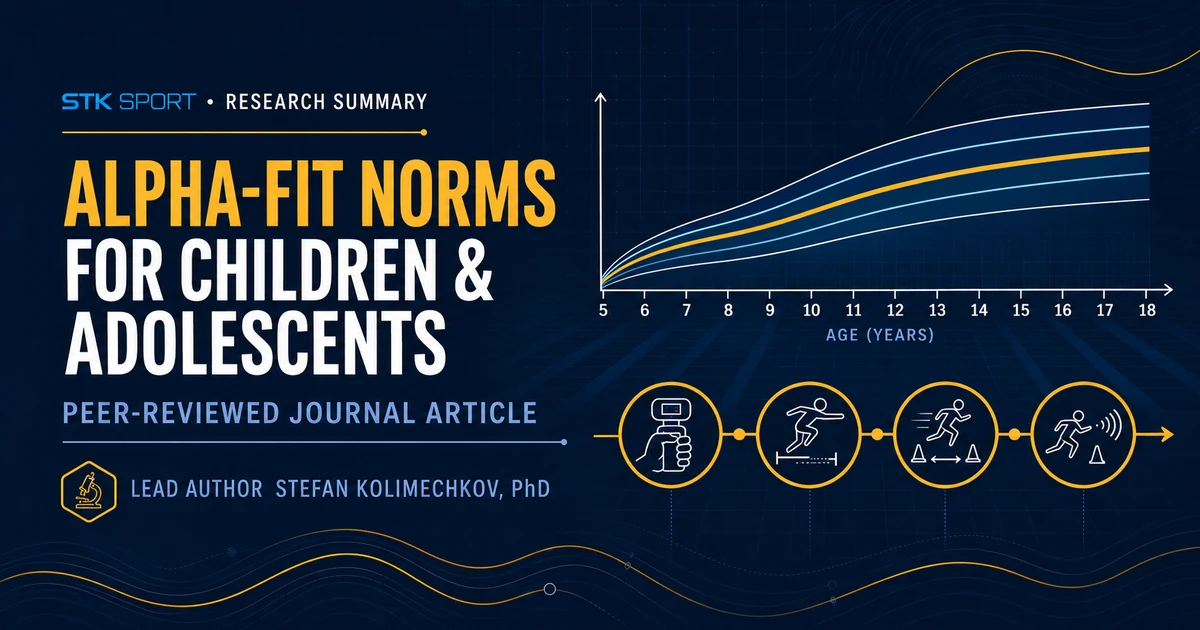
A test score needs an appropriate reference to be interpreted.
The Alpha-fit battery brings together practical field tests for health-related physical fitness in children and adolescents. European reference values were available for younger children and older adolescents, but the published datasets left a gap between 9.9 and 12.9 years for several core measures.
This study addressed that practical problem by connecting existing European and international reference datasets. Its purpose was to provide temporary percentile values until the missing ages could be established through direct experimental research.
Could existing reference datasets be combined and interpolated to support continuous Alpha-fit assessment from 5 to 18 years?
Existing reference data were connected across age groups.
This was a reference-synthesis and interpolation study, not a new participant-testing study. Published percentile values were combined to create sex-specific tables across the full 5–18-year age range.
The values for the missing ages were calculated from existing references. Ages 5 and 18 were estimated by extrapolation, and several percentile columns absent from the source tables were also interpolated.
IDEFICS and HELENA datasets
European norms for children aged 6–9 years and adolescents aged 13–17 years supplied the source values for handgrip strength, standing long jump and the 4 × 10 m shuttle run.
20 m shuttle-run references
European child references were combined with international values for ages 9–17 to produce percentile estimates for maximal oxygen uptake derived from the 20 m shuttle run.
Interpolation and extrapolation
Linear interpolation filled the 9.9–12.9-year gap and missing percentile columns. Extrapolation extended the tables to ages 5 and 18.
A continuous set of temporary Alpha-fit reference tables.
The paper presented sex-specific percentile values for four field-based fitness measures across ages 5–18, while retaining a clear distinction between original and calculated values.
Eight sex-specific percentile tables
Separate tables for girls and boys covered handgrip strength, standing long jump, 4 × 10 m shuttle-run time and 20 m shuttle-run-derived VO₂max.
The 9.9–12.9-year gap was filled
Linear interpolation provided provisional percentile values for the ages missing between the younger-child and adolescent European reference datasets.
Curves changed more sharply between 9 and 13
The combined curves were broadly linear, with a sharper change across these ages. The authors considered puberty a probable explanation, rather than testing that mechanism directly.
The missing ages were not measured directly
The paper did not report new fitness testing. Original source values, interpolated values and age-end extrapolations remained methodologically distinct.
Useful provisional references—with a clearly defined purpose.
The combined tables offered researchers, teachers and coaches a practical way to interpret Alpha-fit results consistently across childhood and adolescence. Their value lies in bridging a documented evidence gap, not in replacing future population measurement.
More consistent field-test interpretation
The tables may support age- and sex-referenced interpretation across four widely used fitness measures when a directly measured value for the relevant age is unavailable.
Calculated values depend on source data
- The missing ages and several percentile columns were estimated by linear interpolation rather than direct testing.
- Values for ages 5 and 18 were extrapolated, and the combined datasets differed in age coverage and population scope.
No diagnostic or universal standard
- The tables do not diagnose health, maturation, ability or sporting potential in an individual child.
- The observed age pattern does not prove that puberty caused the sharper changes, and the provisional references do not replace contemporary measured norms.
Read and cite the paper.
Use the verified journal record or read the complete open-access article.
Kolimechkov, S., Petrov, L., & Alexandrova, A. (2019). Alpha-fit test battery norms for children and adolescents from 5 to 18 years of age obtained by a linear interpolation of existing European physical fitness references. European Journal of Physical Education and Sport Science, 5(4), 1–14. https://doi.org/10.46827/ejpe.v0i0.2221