
The effect of elbow position on the handgrip strength test in children: validity and reliability of TKK 5101 and DynX dynamometers
Pedagogy of Physical Culture and Sports, 24(5), 240–247 · DOI 10.15561/26649837.2020.0504
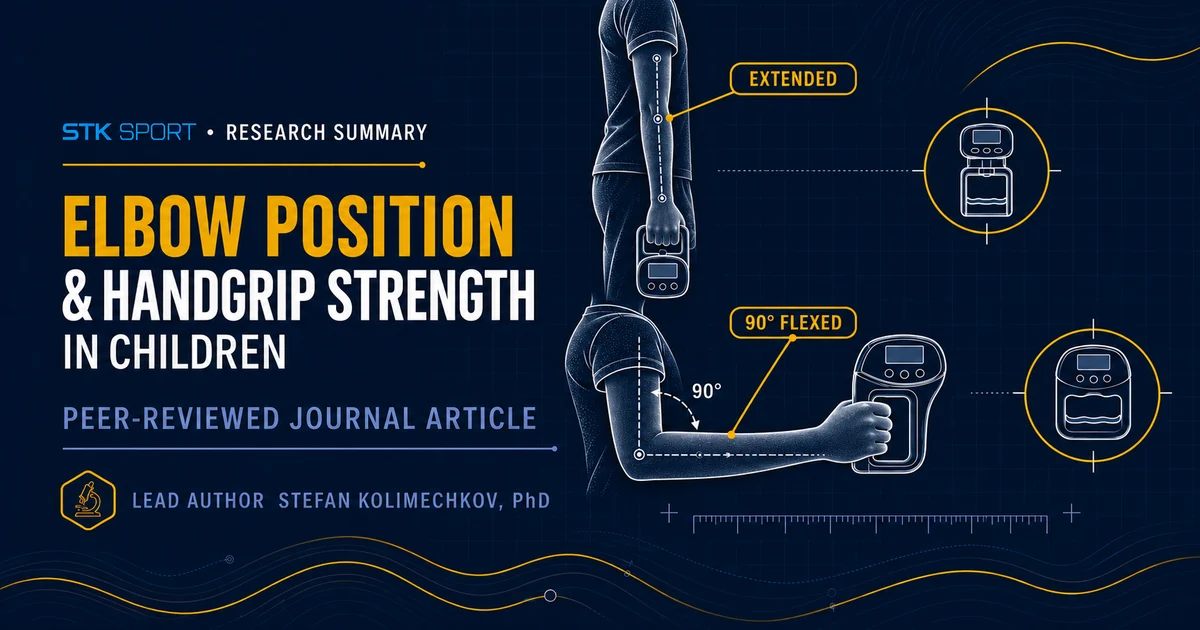
A small change in test position can change the strength value.
Handgrip testing is quick, portable and commonly included in child fitness batteries. For the result to be useful, assessors need a standard protocol that produces maximal, repeatable values and allows fair comparison across settings.
This study compared two elbow positions with two dynamometers while also checking both instruments against known weights. It therefore addressed the child-testing protocol and the measurement quality of the devices.
Which elbow position is more appropriate for maximal handgrip testing in children, and how valid and reliable are the two dynamometers?
A randomised comparison of position and device.
Sixty children aged 6–11 years completed repeated handgrip trials with the TKK 5101 Grip-D and DynX dynamometers at a London primary school.
The test hand, elbow position and dynamometer order were randomised. Each condition was performed twice, with recovery time between attempts and devices.
Grip span and familiarisation
The TKK grip span was adjusted from each child’s hand size; the DynX used its second handle position. Children received standard instructions and held each squeeze for at least two seconds.
Extended and flexed elbows
Each child completed right- and left-hand trials with the elbow fully extended and flexed to 90°. At least 60 seconds separated trials and at least five minutes separated devices.
Known-weight calibration
Validity and reliability were checked using 5–30 kg known weights in 5 kg increments, measured twice in random order. Agreement was evaluated with Bland–Altman analysis.
Full elbow extension produced the higher values.
The extended-elbow position produced greater handgrip strength with both dynamometers, with a larger positional difference for the TKK device.
About 11% higher with the elbow extended
Extended-elbow values exceeded 90°-flexed values by 1.61 kg on the right and 1.64 kg on the left (both p<0.001).
A smaller but significant positional difference
Extended-elbow values were 0.49 kg higher on the right (p=0.035) and 0.57 kg higher on the left (p=0.003), equivalent to approximately 3.6–4.3%.
TKK showed the closer agreement with known weights
The TKK bias was −0.20 kg and was not statistically significant. The DynX bias was −0.42 kg and statistically significant (p<0.001).
Both devices were consistent on repeat testing
Repeat-measurement biases were small and non-significant: −0.07 kg for TKK and +0.10 kg for DynX, with narrow limits of agreement.
Standardising elbow position strengthens child fitness assessment.
Within the tested protocol, full elbow extension was the most appropriate position for obtaining maximal handgrip values in children. The study also provides direct device-validation evidence in the strength range assessed.
Use and report a consistent protocol
Researchers, teachers and coaches can improve comparability by keeping the elbow position, dynamometer model, grip span and trial instructions consistent and reporting them clearly.
How far the findings reach
- The sample came from one London primary school and included 60 children aged 6–11.
- Only two elbow positions and two dynamometer models were examined, so device- and protocol-specific findings should not be generalised without testing.
No universal diagnostic standard
- The study does not show that one device is superior in every age group, population or testing setting.
- It was not a training intervention and does not show that extending the elbow increases a child’s underlying strength.
Read and cite the paper.
Use the verified DOI record or read the open-access paper.
Kolimechkov, S., Castro-Piñero, J., Petrov, L., & Alexandrova, A. (2020). The effect of elbow position on the handgrip strength test in children: Validity and reliability of TKK 5101 and DynX dynamometers. Pedagogy of Physical Culture and Sports, 24(5), 240–247. https://doi.org/10.15561/26649837.2020.0504