
Regional observatory of physical fitness in children and adolescents in Southern Italy: a thirty-year comparison between 1990–2020
Kinesiologia Slovenica, 29(1), 122–137 · DOI 10.52165/kinsi.29.1.122-137
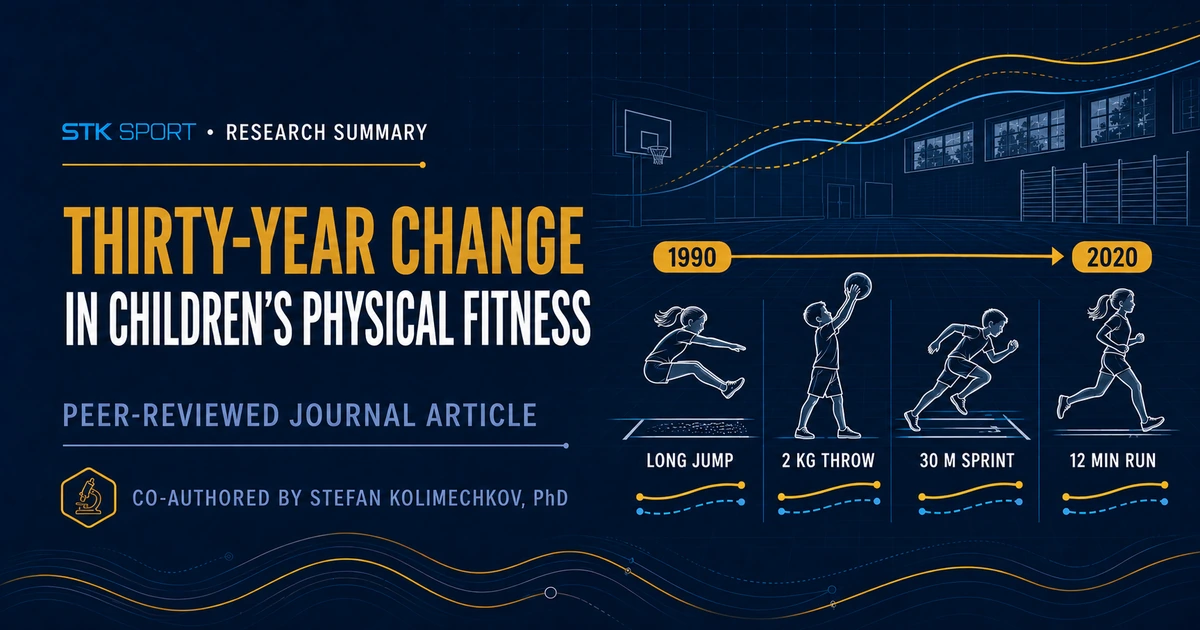
How did schoolchildren’s physical fitness differ after thirty years?
Physical fitness in childhood is connected with participation in movement, motor competence and wider health. Long-term comparisons can therefore provide useful signals for schools and regional monitoring systems.
This study compared pupils assessed in the same Lecce secondary school in 1990 and 2020 using the same four field tests and examined how BMI related to performance in each period.
Did pupils assessed in 2020 show the same strength, speed and endurance profiles as pupils assessed in 1990?
Two independent school cohorts assessed with the same field-test battery.
The researchers compared archival data from 107 pupils assessed in 1990 with 118 pupils assessed in January 2020 at the same school in Lecce.
This was a cross-sectional comparison of two different cohorts. It did not follow the same children for thirty years.
- 1990 cohort107 first-year secondary-school pupils from the observatory archive
- Matched settingFour 2020 classes randomly selected from the same school
- 2020 cohort118 pupils assessed during physical-education lessons
- ComparisonFitness, weight-status distribution and BMI relationships analysed
Four established field tests
Standing long jump, two-kilogram medicine-ball throw, 30-metre dash and the 12-minute Cooper run assessed lower- and upper-body power, speed and endurance.
Height, weight and BMI
Height and weight were measured, BMI calculated, and pupils classified using child and adolescent weight-status cut-offs.
Cohorts and BMI examined
Group comparisons tested 1990 versus 2020 performance, while chi-square and regression analyses examined weight-status distribution and relationships between BMI and test performance.
Lower strength and endurance results accompanied a marked shift in weight status.
Across the total sample, pupils assessed in 1990 performed better in the standing long jump, medicine-ball throw and Cooper run; sprint results did not differ significantly.
Jump and throw performance were lower in 2020
For both normal-weight and overweight/obese groups combined across sex, the 1990 cohort recorded better standing-long-jump and medicine-ball-throw results.
The Cooper-run difference was substantial
Both weight-status groups in 1990 covered more distance in the 12-minute run than their 2020 counterparts, with the paper reporting statistically significant differences.
Thirty-metre sprint times were similar
The total-sample comparisons did not identify significant differences in 30-metre sprint performance for either normal-weight or overweight/obese pupils.
Overweight and obesity were more prevalent in 2020
Across the full sample, the combined proportion classified as overweight or obese increased from 7.5% in 1990 to 39.8% in 2020.
BMI explained more performance variation in 2020
In 2020, BMI accounted for 10.8% of standing-long-jump variance, 11.1% of sprint variance and 13.4% of Cooper-run variance.
Long-term monitoring provided actionable evidence
The study demonstrates how a regional observatory can preserve comparable school-fitness data and identify areas requiring closer educational and public-health attention.
A strong case for sustained school-fitness monitoring and high-quality physical education.
The findings support regular, standardised assessment as a way to understand population-level change and guide age-appropriate opportunities for movement and physical education.
Monitoring can inform educational action
Schools and regional organisations may use repeated fitness assessment to identify changing needs, strengthen teacher training and plan evidence-informed physical-education experiences.
A valuable comparison with defined boundaries
The study compared two independent cohorts from one school rather than tracking the same pupils. The 1990 overweight/obese subgroup was small, and the design could not measure the many social, behavioural or educational changes that occurred between the two periods.
The comparison cannot identify a single cause
- It does not show that BMI alone caused the observed performance differences.
- It does not describe every child in Southern Italy or establish a national trend.
- It does not determine which specific lifestyle, school or environmental changes produced the cohort differences.
Read and cite the paper.
Use the verified journal record or read the complete article hosted on STK SPORT.
Monacis, D., Colella, D., & Kolimechkov, S. (2023). Regional observatory of physical fitness in children and adolescents in Southern Italy: A thirty-year comparison between 1990–2020. Kinesiologia Slovenica, 29(1), 122–137. https://doi.org/10.52165/kinsi.29.1.122-137