
Physical fitness levels of Bulgarian primary school children in relationship to overweight and obesity
Proceeding Book of the International Scientific Congress “Applied Sports Sciences”, 335–339 · DOI 10.37393/ICASS2019/63
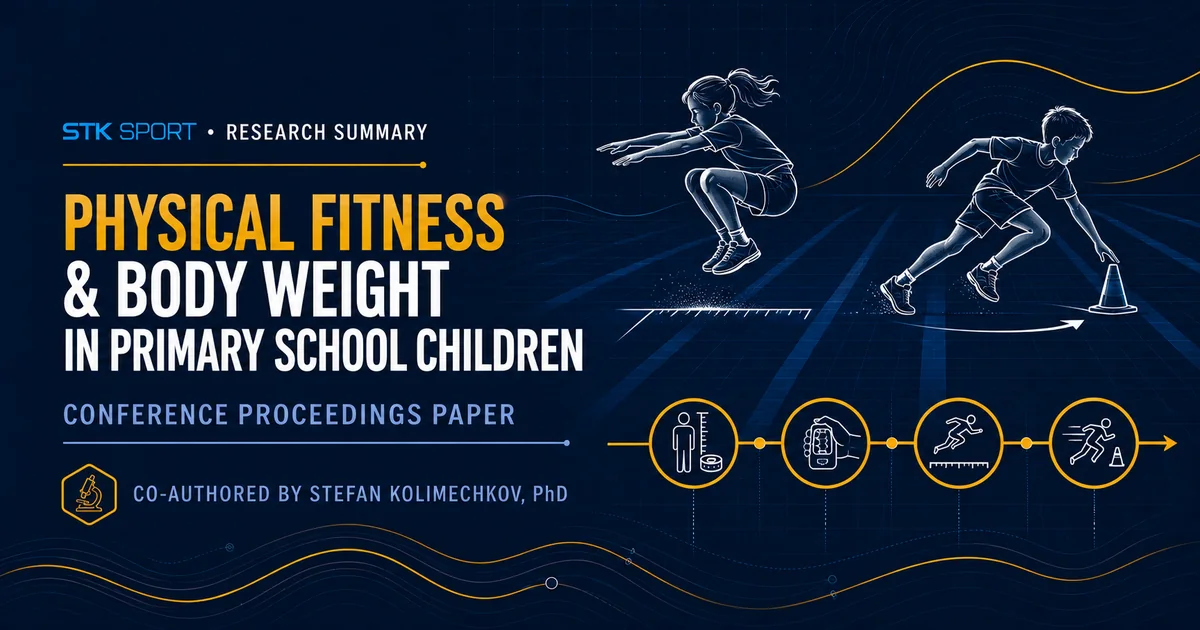
A broader fitness profile can show how body-weight status relates to children’s physical capabilities.
Physical fitness in childhood is associated with current and later health. Schools therefore need practical, standardised field tests that can examine several components safely and compare results with age- and sex-specific reference values.
This study assessed primary school children in Sofia using the Alpha-Fit battery and complementary anthropometric measures. It also compared fitness percentile scores between children not classified as overweight or obese and those who were.
How did health-related fitness differ between children not classified as overweight or obese and those who were?
They combined standardised body measurements with four field-based fitness tests.
The cross-sectional study included 118 children aged seven to eleven from two Sofia primary schools. Parents provided informed consent before testing in spring 2019.
Results were converted to established age- and sex-referenced percentiles where available. The researchers compared girls and boys and then compared 84 children with BMI within the reference range with 34 children classified as overweight or obese.
- Recruit 118 children64 girls and 54 boys from two primary schools in Sofia
- Measure body compositionHeight, weight, waist, arm circumference and two skinfold sites
- Complete Alpha-Fit testsHandgrip, standing long jump, 4×10 m shuttle run and 20 m multistage test
- Compare BMI groupsFitness percentiles were compared by sex and overweight-or-obesity classification
Growth and body-composition context
WHO AnthroPlus supported height, weight and BMI percentile assessment. Waist-to-height ratio, body-fat percentage from skinfold measurements and upper-arm muscle area were also calculated.
Strength, power and agility
Handgrip strength was measured with an individualised grip span, lower-body power with the standing long jump, and motor fitness with the 4×10 m shuttle run.
The 20 m multistage test
BeepShuttle Junior administered the one-minute shuttle-run protocol, estimated maximal oxygen uptake and calculated age- and sex-referenced percentile scores.
Children not classified as overweight or obese performed better in three fitness components.
The clearest differences appeared in lower-body power, motor fitness and cardiorespiratory fitness. Handgrip-strength percentiles did not differ significantly between the BMI groups.
Twenty-nine per cent were classified as overweight or obese
Of the 118 children, 24 (20.3%) were classified as overweight and 10 (8.5%) as obese using WHO BMI percentiles. A further 16 (13.5%) were classified as thin.
The non-overweight-or-obese group had higher jump and shuttle-run percentiles
Standing-long-jump and 4×10 m shuttle-run percentile scores were significantly more favourable in the group not classified as overweight or obese (p<0.05 for both).
The largest fitness difference was cardiorespiratory
Estimated VO2max percentile scores averaged 66.28 in the group not classified as overweight or obese and 44.42 in the overweight-and-obese group (p<0.001).
Handgrip percentiles were similar between BMI groups
Handgrip-strength percentile scores averaged 41.66 and 50.80, respectively, with no statistically significant difference.
Jump and aerobic-fitness scores were above the reference midpoint
Girls and boys averaged around the 60th percentile for standing long jump and estimated VO2max, significantly above the 50th percentile of the international reference values.
Raw scores differed, but fitness percentiles were comparable
Boys recorded higher raw results across the fitness tests, while age- and sex-referenced percentile scores were similar between girls and boys.
Multi-component testing gives schools a more complete picture than weight status alone.
The results support assessing strength, power, motor fitness and cardiorespiratory capacity alongside growth and body-composition indicators. They also show why one test should not be treated as a complete description of a child’s fitness.
Fitness monitoring can identify where support may be useful
The lower jump, shuttle-run and aerobic-fitness percentiles observed in the overweight-and-obese group suggest that schools may benefit from inclusive opportunities that develop several fitness components from an early age.
A focused cross-sectional school sample
- The 118 participants came from two schools in Sofia, so the results should not be treated as nationally representative.
- The cross-sectional design identifies associations at one point in time and cannot establish direction or cause.
- Cardiorespiratory fitness was estimated from a field-based shuttle-run test rather than measured directly in a laboratory.
No diagnosis or universal rule
- BMI categories do not describe every aspect of an individual child’s health or ability.
- The study does not show that body weight alone caused the observed fitness differences.
- The findings do not prescribe one exercise programme or a single fitness target for every child.
Read and cite the paper.
Use the registered DOI or read the complete paper hosted on STK SPORT.
Bonova, I., Kolimechkov, S., Hristov, O., Petrova, B., Kostova, N., & Vekova, A. (2019). Physical fitness levels of Bulgarian primary school children in relationship to overweight and obesity. In T. Iancheva, S. Djobova, & M. Kuleva (Eds.), Proceeding Book of the International Scientific Congress “Applied Sports Sciences” (pp. 335–339). Sofia, Bulgaria: NSA Press. https://doi.org/10.37393/ICASS2019/63