
Kinematic analysis of double back straight somersault and double back straight somersault with full twist on rings
Science of Gymnastics Journal, 13(2), 191–202 · DOI 10.52165/sgj.13.2.191-202
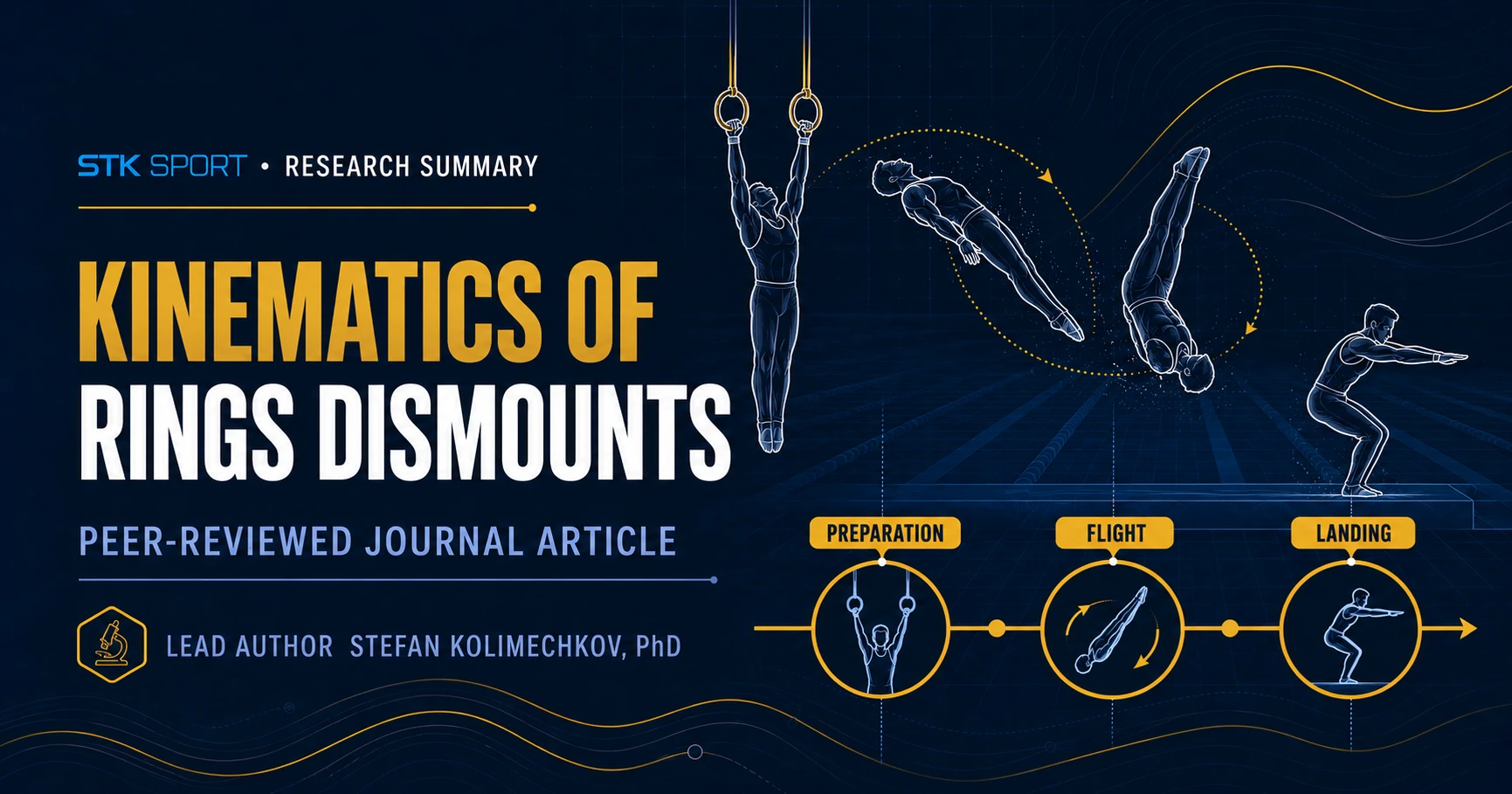
What separates two elite rings dismounts?
The double back straight somersault and its full-twisting variation have been common choices among Olympic and World Championship medallists. Yet rings dismounts are difficult to study because the apparatus moves freely and the gymnast must coordinate the swing, ring action, release and airborne rotation.
The researchers compared two successful dismounts performed by world-class Bulgarian gymnasts, focusing on the descent from handstand, the release and the actions that produced somersaulting and twisting rotation.
How did the movement patterns, joint speeds and angular velocity differ between a double back straight dismount and the same dismount with a full twist?
Two world-class gymnasts analysed from handstand to landing.
Filip Yanev performed the double back straight somersault and Jordan Jovchev performed the full-twisting version in training conditions in Sofia.
A 50 Hz DV camera, a 5 × 3 metre calibration frame and the Ariel Performance Analysis System were used. The recorded movement was transformed into two dimensions and smoothed at a 7 Hz cut-off frequency.
- PreparationDescent from handstand through the backward swing beneath the rings
- ExecutionArching-to-piking action, powerful pull, release and airborne rotation
- LandingCompletion of rotation followed by hip and knee flexion for a stable landing
Two elite specialists
Filip Yanev and Jordan Jovchev, both world-class gymnasts from the Bulgarian National Team, each performed one of the two dismount variations.
Body landmarks digitised
The left foot, knee, hip, shoulder, elbow, hand and head were digitised, together with a reference point on the rings frame.
Speed, trajectory and rotation
The analysis followed shoulder, hip and ankle trajectories and linear velocities. Angular velocity was calculated on the transverse somersaulting axis.
Both dismounts succeeded through powerful, precisely timed actions.
The two gymnasts used similar preparatory actions, but differed around release and in the body configuration used for the straight and full-twisting dismounts.
Peak ankle speed was similar
During the execution phase, peak ankle speed reached 11.11 m/s for the straight dismount and 11.29 m/s for the full-twisting dismount.
Somersaulting angular velocity increased sharply
Angular velocity on the transverse axis rose to 10.0 rad/s for Gymnast 1 and 9.05 rad/s for Gymnast 2 during the execution phase.
The twist began around release
Jordan Jovchev released later and used a slight asymmetrical arm action just before release, initiating rotation around the longitudinal axis during flight.
Arch, pike, pull and leg swing mattered
Both successful performances combined an arching-to-piking action beneath the rings with a powerful pull and strong forward-upward leg swing.
Both gymnasts controlled the landing
Each gymnast accelerated the legs towards the ground, flexed at the hips and absorbed landing through knee flexion into a stable half-squat position.
The skills were prominent among medallists
Among the 62 Olympic and World Championship rings medallists reviewed from 2000 to 2019, 75% used a double back straight variation without, or with, a full or double twist.
A detailed technical comparison, not a universal model.
The paper shows how two elite gymnasts organised successful rings dismounts and identifies actions that may help expert coaches interpret preparation, release and rotation.
Useful cues for advanced coaching
The measured sequences support attention to a stable handstand, sufficient swing beneath the rings, the arching-to-piking action, a powerful pull and carefully timed release. Twisting progressions require specialist coaching, suitable pits and mats, and individual technical judgement.
What constrains the comparison
- The analysis included two elite male gymnasts, each performing a different dismount.
- The single-camera method produced a two-dimensional analysis at 50 Hz, while a full twist is a three-dimensional movement.
- Angular velocity was calculated only on the transverse somersaulting axis.
- The study was descriptive and did not directly measure forces, ring-cable tension, injury risk or learning outcomes.
No single technique for every gymnast
- It does not prove that one release pattern is optimal for all gymnasts.
- It does not compare both dismounts within the same gymnast.
- It does not show that the suggested progressions prevent injury or guarantee successful learning.
Read and cite the paper.
Use the DOI for the permanent scholarly record or read the complete article PDF.
Kolimechkov, S., Yanev, I., Kiuchukov, I., & Petrov, L. (2021). Kinematic analysis of double back straight somersault and double back straight somersault with full twist on rings. Science of Gymnastics Journal, 13(2), 191–202. https://doi.org/10.52165/sgj.13.2.191-202