
Impact of gymnastics training on the health-related physical fitness of young female and male artistic gymnasts
Science of Gymnastics Journal, 11(2), 175–187 · DOI 10.52165/sgj.11.2.175-187
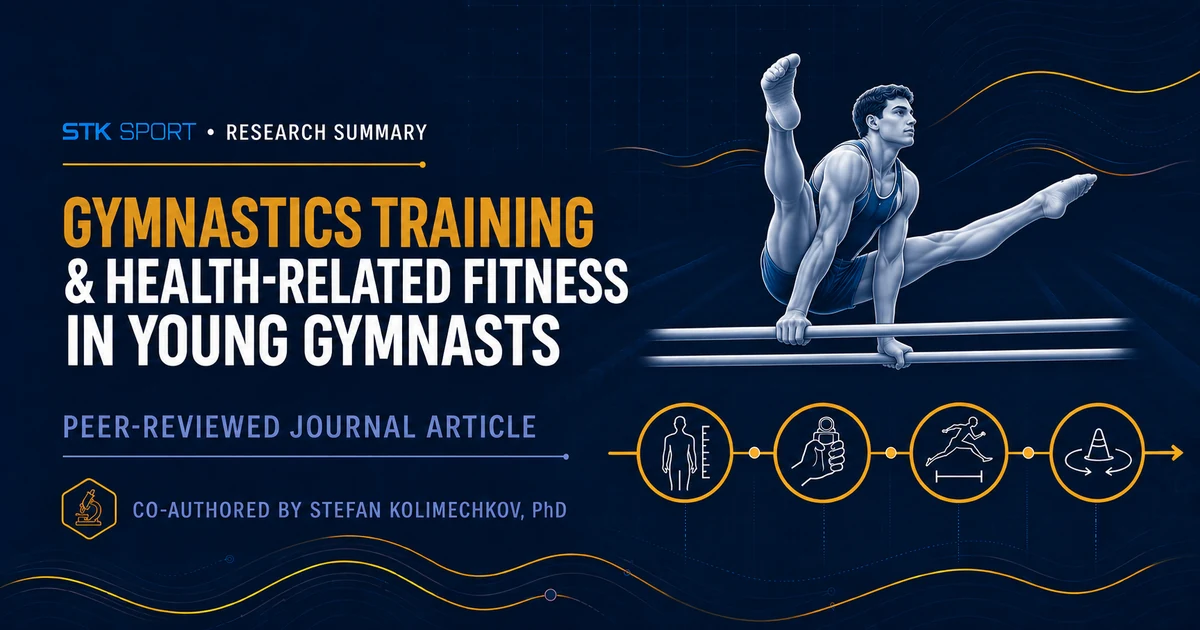
Health-related fitness is broader than a single performance test.
Artistic gymnastics demands strength relative to body mass, explosive power, agility, coordination and the ability to sustain repeated training. Evaluating these qualities alongside growth and body composition provides a more complete view of young athletes’ physical development.
This study examined a large multi-club sample of female and male artistic gymnasts and compared their measurements with international reference percentiles.
What physical-fitness and body-composition profile is seen in young competitive artistic gymnasts when their results are compared with international age references?
A multi-club assessment using an extended Alpha-Fit battery.
The researchers assessed 81 female and 80 male competitive artistic gymnasts aged 5–15 years from nine registered clubs in Sofia, Blagoevgrad, Veliko Tarnovo and Ruse.
This was a cross-sectional observational study. The gymnasts were divided into ages 5–8, 9–11 and 12–15 years and compared with published sex- and age-referenced percentiles.
Experienced competitive gymnasts
The 161 participants represented approximately 25% of the registered young artistic gymnasts in Bulgaria at the time. Their average gymnastics experience was 3.6 years, with training commonly taking place four to six times per week.
Growth and body composition
Height, body mass, waist and arm circumference and triceps and subscapular skinfolds were measured. The researchers calculated BMI, waist-to-height ratio, body-fat percentage and upper-arm muscle area.
Strength, power, agility and aerobic fitness
The extended Alpha-Fit assessment included handgrip strength, standing long jump, the 4 × 10 m shuttle run and a modified shuttle-run test used to estimate maximal oxygen uptake.
The gymnast sample showed a distinctive, multi-component fitness profile.
Explosive lower-body performance was consistently strong, while agility, aerobic fitness, handgrip and growth comparisons varied by sex and age group.
Standing long jump was above the reference midpoint
Female and male gymnasts in every age group recorded standing-long-jump percentiles significantly above the international 50th percentile, indicating a clear explosive lower-body performance advantage in this sample.
Shuttle-run performance was generally strong
All three female age groups and the two older male groups performed significantly above the reference midpoint in the 4 × 10 m shuttle run. The youngest male group did not differ significantly.
Female groups and the youngest boys ranked higher
Estimated aerobic-fitness percentiles were significantly above the midpoint in all female groups and in boys aged 5–8. Results for the two older male groups were not significantly different from the reference midpoint.
Body-fat percentiles were markedly lower
Body-fat percentiles were significantly below the international midpoint in all six sex-and-age groups, and waist-to-height ratios remained below 0.5 throughout the sample.
Handgrip did not show the same advantage
Handgrip percentiles were below the reference midpoint across the groups, significantly so for all female groups and the two younger male groups. The authors noted that body-size-relative reference values may be more informative for gymnasts.
Older groups had lower height percentiles
Height-for-age percentiles were below the reference midpoint in gymnasts aged 9–11 and 12–15. The paper explicitly cautions that this comparison does not show that gymnastics training restricted growth.
The combined pattern is the study’s main contribution.
The sample’s strong jumping, agility and selected aerobic results, together with low body-fat percentiles, align with the physical demands of competitive artistic gymnastics and support assessing young athletes across several fitness components.
Use a broad monitoring profile
Coaches and researchers may gain a more useful picture by considering body composition, explosive power, agility, aerobic fitness and strength together. The findings also support interpreting handgrip in relation to body size rather than relying only on absolute population percentiles.
How far the findings reach
- The cross-sectional comparison with external norms cannot prove that gymnastics training caused the observed profile.
- Some missing age-reference values required interpolation or extrapolation, and aerobic fitness was estimated using a modified 10 m shuttle-run protocol.
No universal rule for children
- Lower height percentiles do not demonstrate that gymnastics training restricted growth.
- The results are not universal fitness targets, selection criteria or prescriptions for every child or gymnast.
Read and cite the paper.
Use the verified DOI record or read the published paper.
Kiuchukov, I., Yanev, I., Petrov, L., Kolimechkov, S., Alexandrova, A., Zaykova, D., & Stoimenov, E. (2019). Impact of gymnastics training on the health-related physical fitness of young female and male artistic gymnasts. Science of Gymnastics Journal, 11(2), 175–187. https://doi.org/10.52165/sgj.11.2.175-187