
The Body Mass Index: A Systematic Review
Journal of Exercise Physiology and Health, 3(2), 21–27
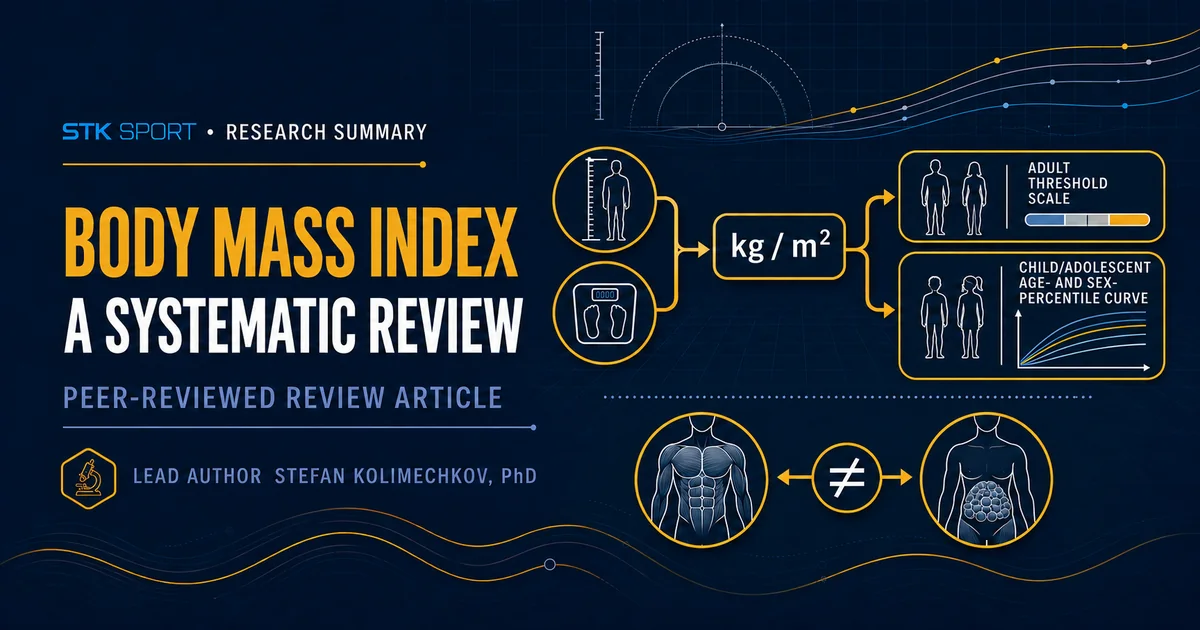
BMI is easy to calculate. Interpreting it well is the harder task.
Body mass index relates body mass to height and is used internationally to screen weight status. Its value lies in simplicity, comparability and extensive reference data. Yet interpretation depends on the person being assessed and the reference system applied.
This review brought together adult classifications, child and adolescent growth references, and the practical limits of BMI in athletic populations. Its central contribution is a clear framework for using a familiar index more appropriately.
Which BMI standards should be used for adults and growing children, and when should BMI be supported by other measurements?
They compared international BMI standards and their practical interpretation.
The authors searched academic databases, reference lists and World Health Organization reports, then synthesised evidence for adults, children, adolescents and athletes.
This was an evidence synthesis. It did not recruit participants or test a new intervention.
- SearchAcademic databases, reference lists and WHO reports to February 2020
- SelectMore than 50 relevant English-language sources retained
- CompareAdult thresholds and child reference systems examined
- InterpretLimits and complementary measures considered for practice
Fixed classification thresholds
The review described BMI calculation and the World Health Organization categories commonly used to classify adult weight status.
Children and adolescents
WHO, CDC and IOTF references were compared because BMI changes with growth and must be interpreted by age and sex.
Body composition and proportions
The authors examined why muscularity and body proportions can affect BMI and discussed complementary anthropometric measures.
BMI remains useful when the right reference and context are applied.
The calculation is consistent, but its interpretation must reflect age, sex, growth and body composition.
Fixed thresholds provide a common framework
For adults, BMI is calculated as weight in kilograms divided by height in metres squared. WHO categories provide widely recognised thresholds for population screening and comparison.
Children require age- and sex-specific references
Because BMI changes during growth and differs between boys and girls, child and adolescent results should be interpreted using percentiles or Z-scores rather than adult cut-offs.
WHO, CDC and IOTF criteria are not interchangeable
The major international systems address the same assessment problem but use different populations, statistical methods and classification cut-offs. The selected reference should therefore be reported clearly.
BMI cannot separate fat mass from muscle mass
Two people with the same BMI may have different body composition. This is especially relevant when evaluating muscular athletes or children engaged in intensive sport.
Complementary measurements add useful context
The review recommended combining BMI with measures such as waist-to-height ratio, body-fat assessment, handgrip strength, arm circumference and upper-arm muscle area when a fuller profile is needed.
A valuable screening index—strongest when used with the correct reference.
The paper clarifies how a familiar measure can support more responsible assessment across adult, paediatric and sporting contexts.
Use BMI as a structured starting point
BMI can support weight-status screening and longitudinal monitoring when practitioners use an age-appropriate standard, report the reference system and interpret the result alongside the person’s wider profile.
A focused synthesis rather than a pooled analysis
- The search was limited to English-language material available up to February 2020.
- The paper did not report a PRISMA flow diagram, formal risk-of-bias assessment or meta-analysis.
- Differences between reference systems can change classification near category boundaries.
BMI is not a direct measure of body fat
- It does not diagnose health or disease on its own.
- It does not distinguish fat, muscle or their distribution.
- It should not be the sole body-composition assessment for athletes or growing children.
Read and cite the paper.
Read the complete article hosted on STK SPORT.
Kolimechkov, S., & Petrov, L. (2020). The Body Mass Index: A Systematic Review. Journal of Exercise Physiology and Health, 3(2), 21–27.