
BeepShuttle Junior: Software for the Administration of the 20m Shuttle Run Test in Children and Adolescents
Journal of Advanced Sport Technology, 1(3), 35–40 · ISSN 2538-5259
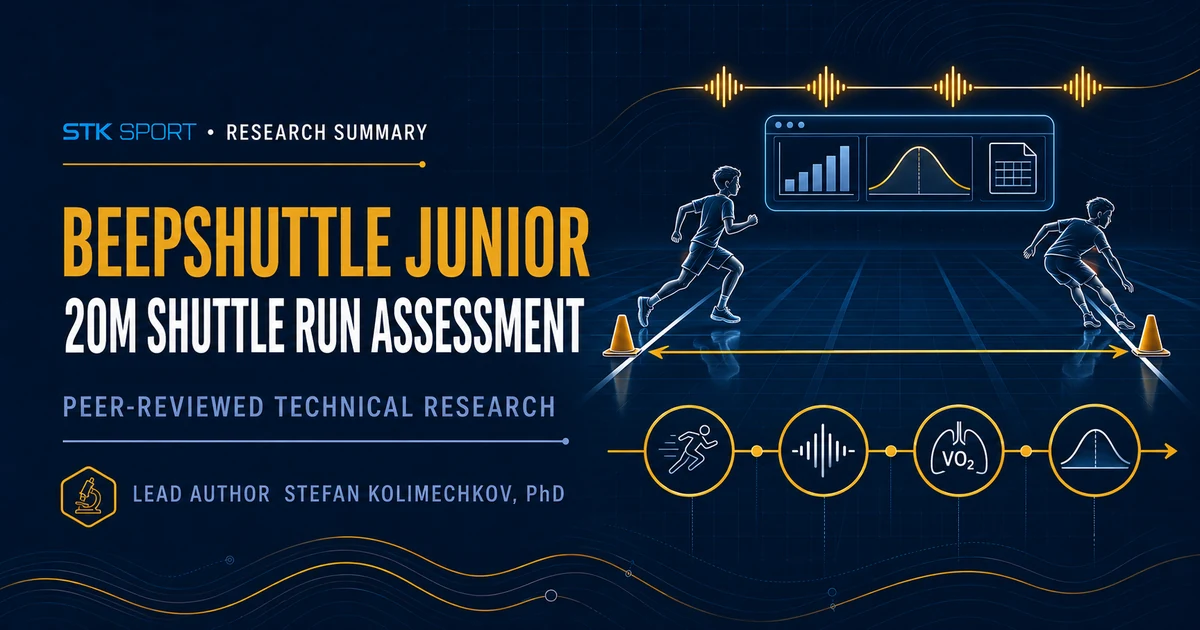
The 20 m shuttle run is practical—but its administration and interpretation can vary.
The 20 m shuttle run is widely used to estimate cardiorespiratory fitness in children and adolescents. Participants run between two lines in time with progressively faster audio signals, making the test suitable for schools, sports clubs and research settings where laboratory measurement may be impractical.
The paper identified several practical difficulties: following stages and shuttles accurately, reporting comparable outcomes, and interpreting results against age- and sex-specific references. BeepShuttle Junior was developed to bring test administration, calculation and classification into one system.
Could purpose-built software administer the test and produce consistent age- and sex-referenced assessments for young people?
The software was used during a standard 20 m shuttle-run test.
Sixty-three children from a London primary school completed one test after a warm-up and familiarisation. BeepShuttle Junior administered the protocol and calculated each participant’s estimated VO₂max and percentile assessment.
The study was conducted in 2016 with school approval and parent or guardian consent. The software used published equations and reference standards rather than directly measuring oxygen uptake.
63 children aged 6–9 years
Thirty-one girls and 32 boys completed the test at St Edmund’s Catholic Primary School in London, wearing PE clothing and footwear.
Progressive one-minute stages
The original Léger protocol began at 8.5 km/h and increased by 0.5 km/h each minute. Children ran between lines 20 m apart in time with the audio signals.
Estimated VO₂max and percentiles
The software used the final completed running speed and age to estimate VO₂max, then applied age- and sex-specific references by linear interpolation. Results could be exported as a CSV file.
The software reproduced the intended calculations and classifications.
The central validation result was computational: the individual software results and assessments matched the interpolated normative tables used as the reference.
Assessments matched the reference tables
The software’s individual percentile scores and classifications exactly matched the interpolated normative data tables used for verification.
Boys had higher estimated VO₂max
Mean estimated VO₂max was 47.71 ± 3.13 ml/kg/min for boys and 45.85 ± 2.17 ml/kg/min for girls; the difference was statistically significant.
Mean percentile scores were similar
Despite the difference in estimated VO₂max, mean age- and sex-referenced percentile scores were similar for boys and girls: 53.17 ± 23.64 and 53.90 ± 22.14.
Higher BMI Z-scores accompanied lower estimates
BMI Z-score was negatively correlated with estimated VO₂max in girls (r = −0.54, p = 0.002) and boys (r = −0.44, p = 0.011).
A practical bridge between field testing and consistent interpretation.
The study demonstrated how software could reduce manual administration and calculation steps while applying a consistent protocol and reference framework. This is particularly relevant to schools, sports clubs and research projects testing groups of young people.
Fewer manual steps and clearer outputs
Audio-visual pacing, automatic calculations, percentile classification and CSV export may help practitioners record and interpret the same field test more consistently.
A focused software-validation study
- The participant evaluation involved one London school and 63 children aged 6–9, although the software’s reference system covered ages 6–17.
- One field-test trial was performed; the study did not report test–retest reliability or comparison with directly measured laboratory VO₂max.
No direct or diagnostic measurement
- The software estimates VO₂max from shuttle-run performance and a published equation; it does not measure oxygen uptake directly.
- The results do not establish a diagnosis, universal fitness standard or current software compatibility beyond the systems and reference data described in 2018.
Read and cite the paper.
Use the preserved research record or read the complete article PDF.
Kolimechkov, S., Petrov, L., Alexandrova, A., & Cholakov, K. (2018). BeepShuttle Junior: Software for the administration of the 20m shuttle run test in children and adolescents. Journal of Advanced Sport Technology, 1(3), 35–40.