
The effect of trainability on the physical fitness of young athletes
Journal of Applied Sports Sciences, 1, 57–72 · DOI 10.37393/JASS.2022.01.5
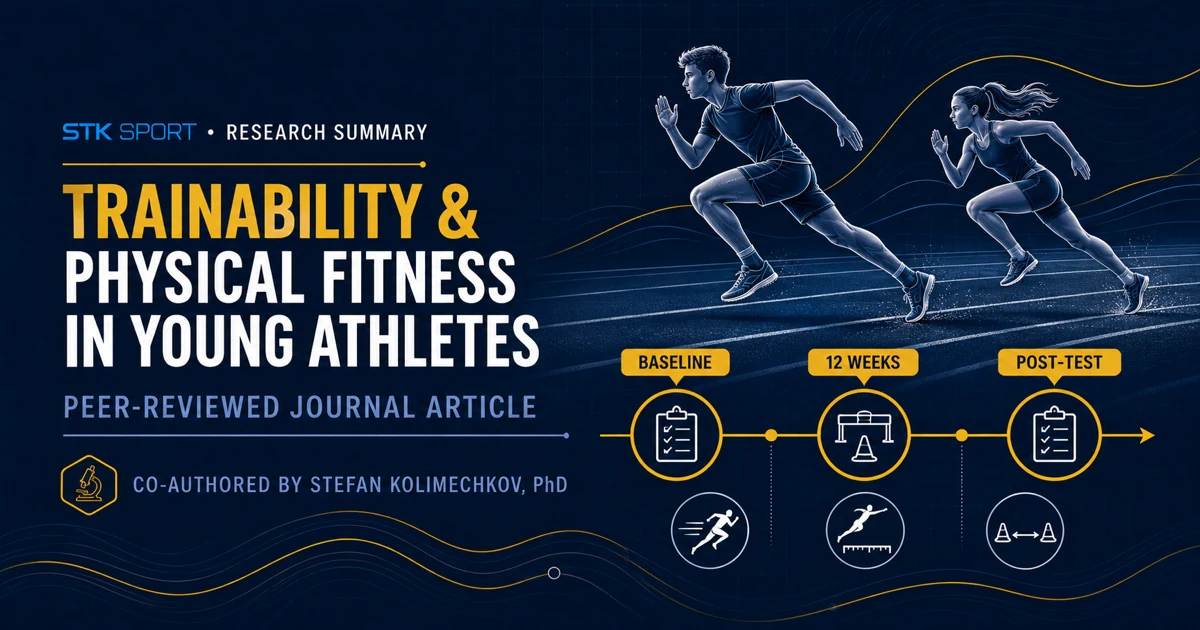
Training responsiveness matters during adolescent athlete development.
Trainability describes how an athlete adapts to a training stimulus. During adolescence, growth, maturation, sporting experience and programme design can all influence the rate and pattern of change.
This study tested whether a structured programme designed around the expected transfer between physical qualities was associated with broader fitness improvements than the athletes' usual training approach.
How did 12 weeks of specialised, age-appropriate athletics training affect health-related and sport-specific physical fitness in young athletes?
A 12-week field study across four athletics clubs.
Fifty-two competitive athletes aged 13–15 years from Sofia, Plovdiv, Blagoevgrad and Vratsa completed physical fitness testing before and after the training period.
The experimental groups followed the specialised programme; the control groups continued programmes provided by their coaches. Allocation reflected club participation and consent rather than random assignment.
Competitive adolescent athletes
The sample included 24 boys and 28 girls with at least two years of athletics experience and regular training of three to five two-hour sessions per week.
Multiple physical qualities
The specialised programme combined sprinting, endurance running, jumps, medicine-ball work, strength-endurance and mobility across a structured weekly schedule.
Health-related and specific fitness
Testing included handgrip strength, standing long jump, 4 × 10 m shuttle run, 20 m shuttle run, 30 m sprint, 600 m run and triple jump, alongside body-composition measures.
The specialised groups improved across several fitness domains.
After 12 weeks, both female and male experimental groups recorded significant improvements in multiple health-related and sport-specific tests, with the largest reported changes in jumping, sprinting and agility.
Standing long jump improved in both experimental groups
Boys improved from 184.57 to 200.79 cm (p<0.01; effect size 0.8), while girls improved from 179.07 to 183.93 cm (p<0.05; effect size 0.3).
Faster sprint and shuttle-run performances
The 30 m sprint and 4 × 10 m shuttle run improved significantly in both experimental groups. Reported effect sizes were 0.7 for these changes.
All three athletics tests improved
Experimental-group performances improved significantly in the 30 m sprint, 600 m run and triple jump. The control groups improved in sprint and 600 m performance but not significantly in triple jump.
No significant VO₂max change in the experimental groups
Estimated aerobic capacity from the 20 m shuttle run did not change significantly in the experimental groups, although 600 m running performance improved.
Structured field testing can help coaches track adolescent development.
In this sample, the specialised programme was associated with broad improvements in explosive power, speed, agility and sport-specific performance. The findings support careful monitoring rather than a one-size-fits-all definition of talent.
Match training to developmental needs
A mixed programme that deliberately develops interacting physical qualities may help adolescent athletes improve across several field tests. Repeated assessment can show where responses are strongest or remain unchanged.
How far the findings reach
- The four groups were small, differed in age and were formed through club participation and consent rather than random allocation.
- The 12-week findings came from Bulgarian athletics clubs and need confirmation in larger, longer and more diverse studies.
No universal talent-prediction rule
- The study did not directly compare experimental and control groups statistically because of their age differences.
- Short-term improvement does not prove a fixed sensitive period or predict long-term sporting success.
Read and cite the paper.
Use the verified DOI record or read the open-access paper.
Bonova, I., Kolimechkov, S., Mavrudiev, P., Mitsov, D., & Dasheva, D. (2022). The effect of trainability on the physical fitness of young athletes. Journal of Applied Sports Sciences, 1, 57–72. https://doi.org/10.37393/JASS.2022.01.5