
Competitive stress assessment using salivary biomarkers in rhythmic gymnasts
Kinesiologia Slovenica, 31(1), 100–118 · DOI 10.52165/kinsi.31.1.100-118
Can saliva measures complement anxiety questionnaires before competition?
Rhythmic gymnasts prepare under considerable technical, physical and performance pressure. Questionnaires can describe perceived anxiety, while saliva offers a practical route to observing parts of the body’s stress response without blood sampling.
This field study brought both approaches together around a real national championship, tracking the same gymnasts from a home baseline through training and into competition day.
Do salivary alpha-amylase, protein and potassium change alongside reported anxiety as competition approaches?
Repeated non-invasive assessments in the athletes’ real competitive setting.
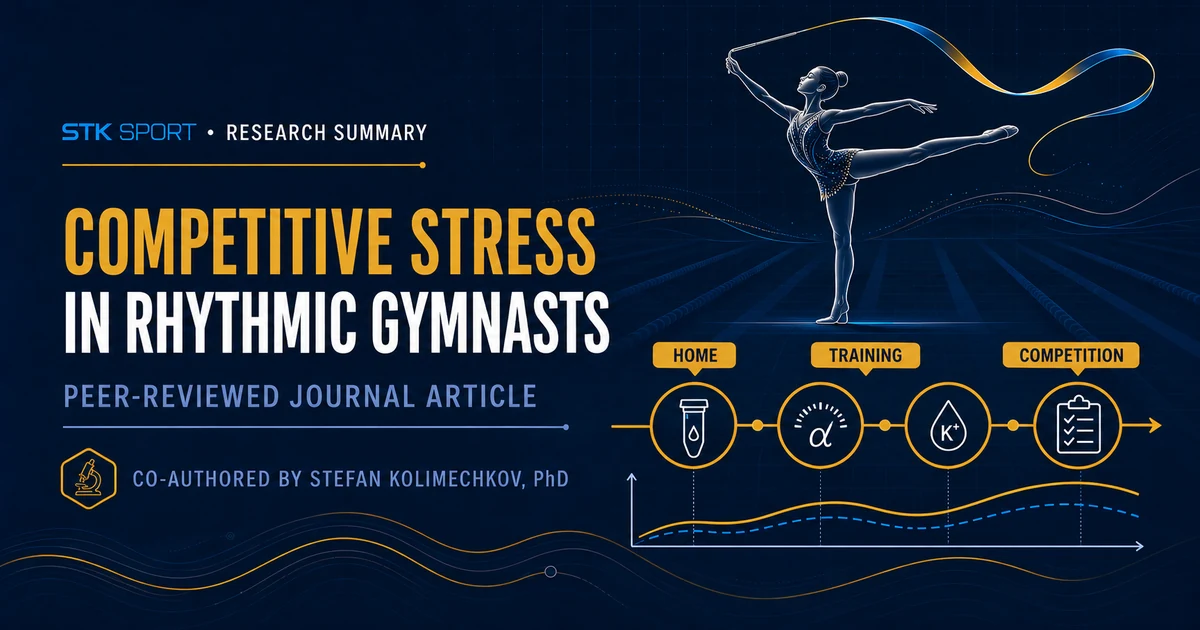
The same ten national-level gymnasts were assessed from a home baseline through their final training period and into the day of the Bulgarian Rhythmic Gymnastics Championships.
Collection timing and pre-sampling behaviours were standardised to reduce avoidable variation between the three saliva samples.
- HomeBaseline at 10:00, nine days before the championship
- TrainingAbout 30 minutes before training, five days before competition
- CompetitionAbout one hour before the group routines on competition day
Three biochemical markers
Unstimulated saliva collected with cotton-swab Salivettes was analysed for alpha-amylase activity, protein concentration and potassium concentration.
Validated questionnaire assessment
The State-Trait Anxiety Inventory measured trait and state anxiety at home; state anxiety was repeated after the training and competition saliva samples.
Within-athlete comparison
Repeated-measures ANOVA with Tukey post-hoc comparisons tested changes across the three time points, with results reported as means and standard deviations.
Biochemical and questionnaire measures both rose as competition approached.
The clearest group-level changes involved salivary alpha-amylase, salivary potassium and state anxiety, while individual patterns still varied.
Alpha-amylase activity increased
Mean salivary alpha-amylase was higher before training (6.56 ± 0.58) and competition (6.90 ± 0.70 ln(U/mL)) than at home (5.89 ± 0.75), with both comparisons reaching p < 0.05.
Potassium was highest before competition
Mean salivary potassium reached 35.73 ± 8.30 mmol/L before competition versus 23.94 ± 4.83 mmol/L at home (p < 0.01).
State anxiety also increased
Mean state-anxiety scores were higher before training (36.90 ± 11.03) and competition (40.10 ± 9.57) than at home (30.80 ± 10.26), with p < 0.05 for both comparisons.
Protein increased numerically
Mean salivary protein rose from 1.84 to 2.28 and 2.91 g/L across the three assessments, but the differences were not statistically significant.
Responses were not identical
Six gymnasts had their highest alpha-amylase result before competition, while three recorded their highest value before training. Competition potassium was highest in eight of ten gymnasts.
Anxiety scores tracked consistently
State- and trait-anxiety measures were strongly correlated across assessment points. The only significant cross-time alpha-amylase association was between home and pre-training values.
A practical step towards more complete competition-stress monitoring.
The study’s contribution is the combined use of non-invasive saliva measures and a validated anxiety questionnaire in a real championship setting. Salivary alpha-amylase and potassium showed particular promise as objective additions to athlete monitoring.
Complementary information for support teams
Tracking perceived anxiety alongside selected saliva markers may help coaches and sport psychologists recognise individual responses and tailor preparation or support. These measures are most useful when interpreted together and over time.
A focused national-level sample
The study included ten gymnasts from two group teams at one championship. The authors identify this sample size as the principal limitation and call for replication in larger, more diverse groups.
No diagnostic threshold or performance prediction
- The results do not define a universal cut-off for harmful competition stress.
- A higher biomarker value does not by itself explain whether an athlete experiences arousal positively or negatively.
- The study does not show that monitoring alone improves competition performance.
Read and cite the paper.
Use the verified DOI or read the complete published article hosted on STK SPORT.
Petrov, L., Gateva, M., Alexandrova, A., & Kolimechkov, S. (2025). Competitive stress assessment using salivary biomarkers in rhythmic gymnasts. Kinesiologia Slovenica, 31(1), 100–118. https://doi.org/10.52165/kinsi.31.1.100-118